



Natural stone dials: materials, origins, and symbolism
Traditional horology has accustomed us to dials fashioned from brass, steel, or silver, meticulously guilloché, lacquered, or enamelled. Yet, at the heart of this quest for aesthetic perfection, nature offers a raw and striking alternative. Integrating a mineral fragment into a watch transforms a simple measuring instrument into a true geological masterpiece.
Opting for a natural stone dial means choosing to wear on one's wrist a material shaped over millions of years by the Earth itself. But beyond their undeniable visual appeal, these mineral discs demand extraordinary technical expertise. Let us dive into the heart of these organic materials to understand their nature, their fascinating origins, and the profound symbolism they breathe into the reading of time.
What is a natural stone dial?
To understand the essence of a watch with a natural stone dial, one must redefine the very structure of the watch's face. Traditionally, a dial is a thin metal disc onto which indices and numerals are applied or painted. It is the result of a complex, yet reproducible, industrial or artisanal process.
A natural stone dial, conversely, is a fine slice of hard rock, mineral, or gemstone, cut directly from a raw block. It replaces the usual metal base to provide a surface where patterns, veins, and reflections are not created by human hands, but fashioned by nature.
The fundamental difference from a classic dial lies in the absolute uniqueness of the material. While a lacquer bath or a guilloché cutter guarantees the homogeneity of a watch series, natural stone imposes its own character. Its imperfections, crystalline inclusions, and variations in opacity make each dial an irreplaceable piece. It is the introduction of the random and the organic into a mechanical world that is, by definition, strict and millimetric.

Comparison between a brushed steel dial and a tiger's eye natural stone dial, illustrating the contrast between a metallic finish and a natural mineral material.
Origins and appearance in watchmaking
While the use of precious stones to adorn the cases or covers of pocket watches dates back several centuries, the integration of pure stone as a dial appeared much later. Historically, watchmakers preferred enamel or porcelain materials offering high legibility and a perfectly smooth surface for inscribing the hours.
The progressive use of hard stones in dial design truly took flight with the evolution of the wristwatch and advancements in precision tooling. The ability to cut extremely thin slices of rock opened up new creative perspectives.
Over the decades, this technique has risen to the rank of a signature for many prestigious watchmaking houses. This work on the material has become a symbol of excellence, testifying to a manufacturer's ability to tame complex natural elements and combine them with the technical requirements of horology.
How are stone dials manufactured?
The manufacturing of a natural stone dial is one of the most delicate exercises in horological craftsmanship. The process begins long before the workshop, with the meticulous selection of the raw stone block. The lapidary artisan searches for areas where the veining is most harmonious, the colour most profound, and the crystalline structure most stable.
Once the stone is selected, the cutting stage begins. This is where the greatest technical difficulty lies. A watch dial must generally have a thickness of less than a millimetre (often between 0.4 and 0.8 mm) so as not to obstruct the passage of the hands or thicken the case. Cutting a hard rock into such a fine sliver exposes the material to an extremely high risk of shattering. The loss rate during this stage can be considerable.
The artisanal work continues with meticulous polishing to reveal the mineral's brilliance. The dial is then reinforced on a thin metal base to ensure its resistance. Drilling the holes intended for the hand axes or to fix applied indices requires a level of precision where the slightest excessive vibration can irretrievably crack the finished dial.
The main stones used in watchmaking
The mineral palette offered by nature is vast, but certain rocks stand out for their aesthetic qualities and their compatibility with horological constraints.
Aventurine:
Although a distinction exists between aventurine glass (man-made in the 17th century) and natural aventurine quartz, the aventurine dial is fascinating. Its surface, dotted with tiny shimmering inclusions, invariably evokes a starlit celestial vault, capturing the light with every movement of the wrist.
Malachite:
Immediately recognisable by its intense green nuances, malachite is distinguished by its concentric lines and fluid ribbons. It lends the dial a hypnotic appearance, reminiscent of the luxuriance of dense forests or the curves of topography.
Onyx:
To achieve the deepest and most absolute black in watchmaking, onyx is the quintessential choice. Once perfectly polished, this stone offers a mirror-like surface of rare elegance, creating a striking contrast with steel or gold hands.
Lapis-lazuli:
This deep ultramarine blue mineral is often speckled with golden pyrite inclusions. A lapis-lazuli dial gives the illusion of observing the Earth from space, offering exceptional visual depth.
Moonstone and Mother-of-pearl:
Although mother-of-pearl is organic in origin (derived from shells), it shares with moonstone that unique ability to play with light through iridescent effects. Their milky or coloured reflections bring a softness and changing luminosity to the face of the watch.
 Presentation of several natural stones used for watch dials: aventurine, malachite, onyx, lapis-lazuli, and moonstone.
The uniqueness of every dial
The magic of a hard stone dial lies in its inherent exclusivity. By definition, it is strictly impossible to find two identical watches when their dial is carved from rock. Nature acts here as the sole designer.
Natural variations whether in the arrangement of malachite's veins, the density of aventurine's sparkles, or the intensity of lapis-lazuli's blue guarantee that the wearer possesses a truly unique piece. Opacities vary, and inclusions reveal themselves differently under the sun's rays.
This behaviour towards light is an essential component of the stone's singularity. The dial does not freeze the watch's aesthetic; it evolves according to the room's lighting, the angle of the wrist, or the time of day, offering a perpetually renewed spectacle.
Symbolism and perception of the stones
Beyond technical achievement and aesthetic success, natural stones carry a powerful symbolic weight that resonates particularly within the world of horology. Since Antiquity, civilisations have attributed profound meanings to minerals: lapis-lazuli was the stone of royalty and wisdom in Egypt, onyx has long embodied strength and grounding, while aventurine is associated with vitality.
Wearing such a dial creates a special emotional bond. There is a philosophical dimension to observing time pass on a fragment of rock that is tens, if not hundreds, of millions of years old.
In horological perception, stone introduces a form of permanence and eternity against the fleeting nature of the passing second. It is the fascinating contrast between the frenetic dynamics of the mechanical or quartz movement beating the measure, and the static, millennial silence of the mineral dial.
The stone dial in watchmaking
The use of stone in watchmaking responds to a desire for aesthetic exploration. Without resorting to synthetic pigments or complex chemical treatments, watchmaking houses draw from the rock a source of pure colours and unprecedented textures.
This material finds its place both in extremely minimalist designs where the dial, devoid of any indices, allows the material to speak for itself and in high horology pieces where the stone highlights the complexity of a tourbillon or a moon phase.
The positioning of these dials is part of an authentic design approach. They appeal to lovers of fine mechanics who are also sensitive to the integrity of materials. Natural stone thus casts an elegant bridge between the rigour of human mechanical genius and the raw, random beauty of nature.

Piaget Andy Warhol watch in rose gold, featuring a natural malachite dial with characteristic green veins.
Source: Piaget - Andy Warhol Watch - official image, editorial/press use
 Vacheron Constantin Métiers d’Art Tribute to Great Civilisations watch, Athena of Velletri, featuring a finely sculpted and hand-worked stone dial.
Source: Vacheron Constantin - Métiers d’Art Tribute to Great Civilisations, Athena of Velletri - official image, editorial/press use
Conclusion
The choice to integrate minerals into the design of a timepiece goes beyond a mere desire for ornamentation. A natural stone dial is the culmination of a complex dialogue between high-precision craftsmanship and the indomitable beauty of nature. Every meticulous cut of onyx, malachite, or lapis-lazuli gives birth to a fundamentally unique piece, charged with a millennial history.
At Gustave & Cie, we have always placed primary importance on the aesthetics of time and the nobility of materials. While our philosophy celebrates, above all, the elegance of simplicity and the French *art de vivre*, we share with these mineral creations that same passion for objects that tell a story and sublimate time rather than endure it. A timepiece is never a simple tool; it is a reflection of the person who wears it.
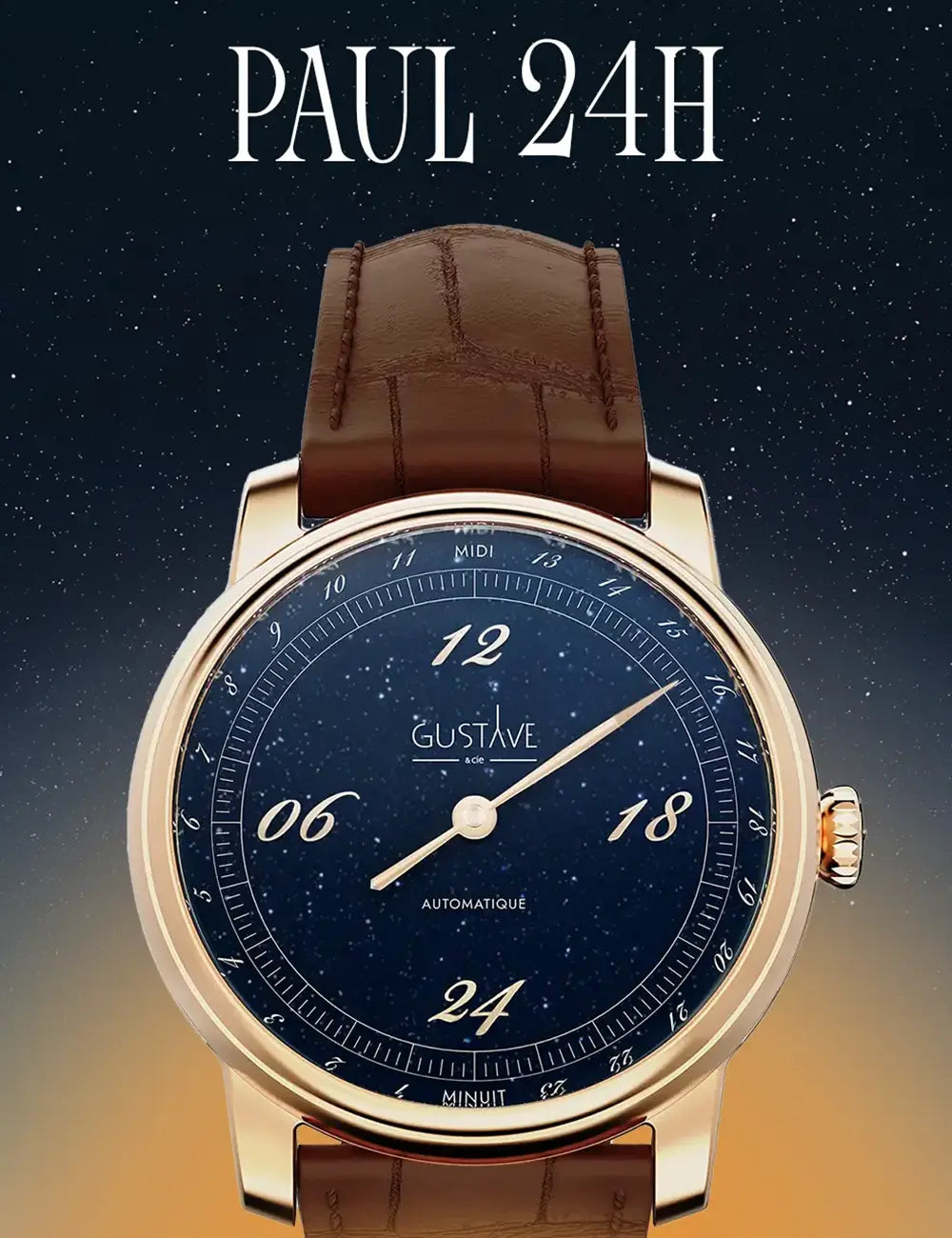
EXPLORE OUR PAUL 24H COLLECTION WITH THE AVENTURINE DIAL
Leave a comment
This site is protected by hCaptcha and the hCaptcha Privacy Policy and Terms of Service apply.