







Preserving a Watch's Water Resistance: Maintenance and Durability
A watch is a marvel of micromechanics, designed to accompany you through the most intense moments of your life. Yet, a common misconception persists: the belief that a certified water-resistant watch will remain so indefinitely. In reality, a timepiece's resistance to water and dust is not a fixed state, but a dynamic characteristic that evolves with time and use.
Understanding how to preserve a watch's water resistance is fundamental to guaranteeing the longevity of its movement, whether quartz or automatic. A single infiltration, invisible to the naked eye, can be enough to oxidize the internal components and freeze the mechanism. Through this guide, we invite you to discover the hidden side of horological water resistance: from the lifespan of gaskets to daily best practices, here is how to lastingly protect the integrity of your watch.
Water resistance is not eternal
To understand why a watch's water resistance is not guaranteed for life, one must look at its design. The impermeability of a case relies on a system of gaskets (often called O-rings), judiciously placed at critical points: under the case back, around the crystal, and inside the crown tube.
These gaskets, typically made of rubber, silicone, or synthetic polymers, are living materials. Over the years, they undergo natural aging. They tend to dry out, develop micro-cracks, and lose their elasticity. This degradation leads to a progressive loss of the watch's ability to repel water.
Furthermore, the role of usage conditions is decisive in this aging process. A watch worn daily to the office will not experience the same structural wear as a watch regularly exposed to seawater, temperature variations, or sports activities. Water resistance is therefore a fragile balance that must be monitored.
The invisible factors that degrade water resistance
Even with the greatest care, your watch is constantly subjected to external aggressions that accelerate the wear of its protections. Several environmental and behavioral factors are particularly formidable:
-
Thermal shock: Moving suddenly from high temperatures to cold water causes the materials to expand and contract rapidly. Over time, these repeated stresses can weaken the watch’s water-resistance seals.
-
Salt and chlorine: Both seawater and chlorinated water accelerate the ageing of water-resistance seals. Rinsing your watch with fresh water after every swim is strongly recommended.
-
Impacts: A fall or knock can slightly deform the case or shift the crystal, compromising the watch’s water resistance without any visible signs of damage.
-
The crown: A crown that is not fully screwed down, or one that is operated while the watch is in the water, is one of the leading causes of water ingress.
-
Chemicals: Perfumes, creams and solvents can gradually damage the seals and reduce their effectiveness.
Protecting your watch’s water resistance in everyday use
Preserving your watch’s water resistance is mainly a matter of adopting a few simple habits. By following these everyday precautions, you can minimise the risk of water ingress and help extend the lifespan of your timepiece.
-
Rinse your watch after every swim: After swimming in the sea or a swimming pool, rinse your watch thoroughly with fresh water to remove salt, chlorine and sand residue. Then dry it gently with a microfibre cloth.
-
Avoid hot showers and saunas: Water vapour is finer than liquid water and can penetrate the case more easily. Heat also weakens the water-resistance seals. Even a dive watch is not designed for repeated exposure to steam.
-
Always check the crown before contact with water: Make sure it is fully pushed back against the case, or securely screwed down if your watch is fitted with a screw-down crown.
-
Protect your watch from thermal shock: Avoid moving abruptly from high temperatures to cold water. Sudden temperature changes place significant stress on the water-resistance seals.
-
Store your watch in a dry place: When you’re not wearing it, keep it away from humidity, direct sunlight and extreme temperature fluctuations.
Professional intervention: an essential step
Despite all your precautions, the intervention of a professional remains indispensable to guarantee the safety of your timepiece. Horological maintenance is not limited to overhauling the movement; it includes a rigorous check of the case's integrity.
The water resistance test is a quick procedure carried out in a workshop. Using specific machines (dry testing via air overpressure and underpressure, or wet testing), the watchmaker checks if the case has any micro-leaks. It is recommended to perform this test on a regular basis.
The frequency of this maintenance depends on your usage. For a watch submerged very regularly (swimming, diving), an annual test before the summer season is ideal. For standard or urban use, a check every 2 to 3 years, or even 3 to 5 years depending on the range and the manufacturer's recommendations, is sufficient. During this service, the watchmaker will lubricate or systematically replace tired gaskets, thereby restoring your watch's original protective properties.

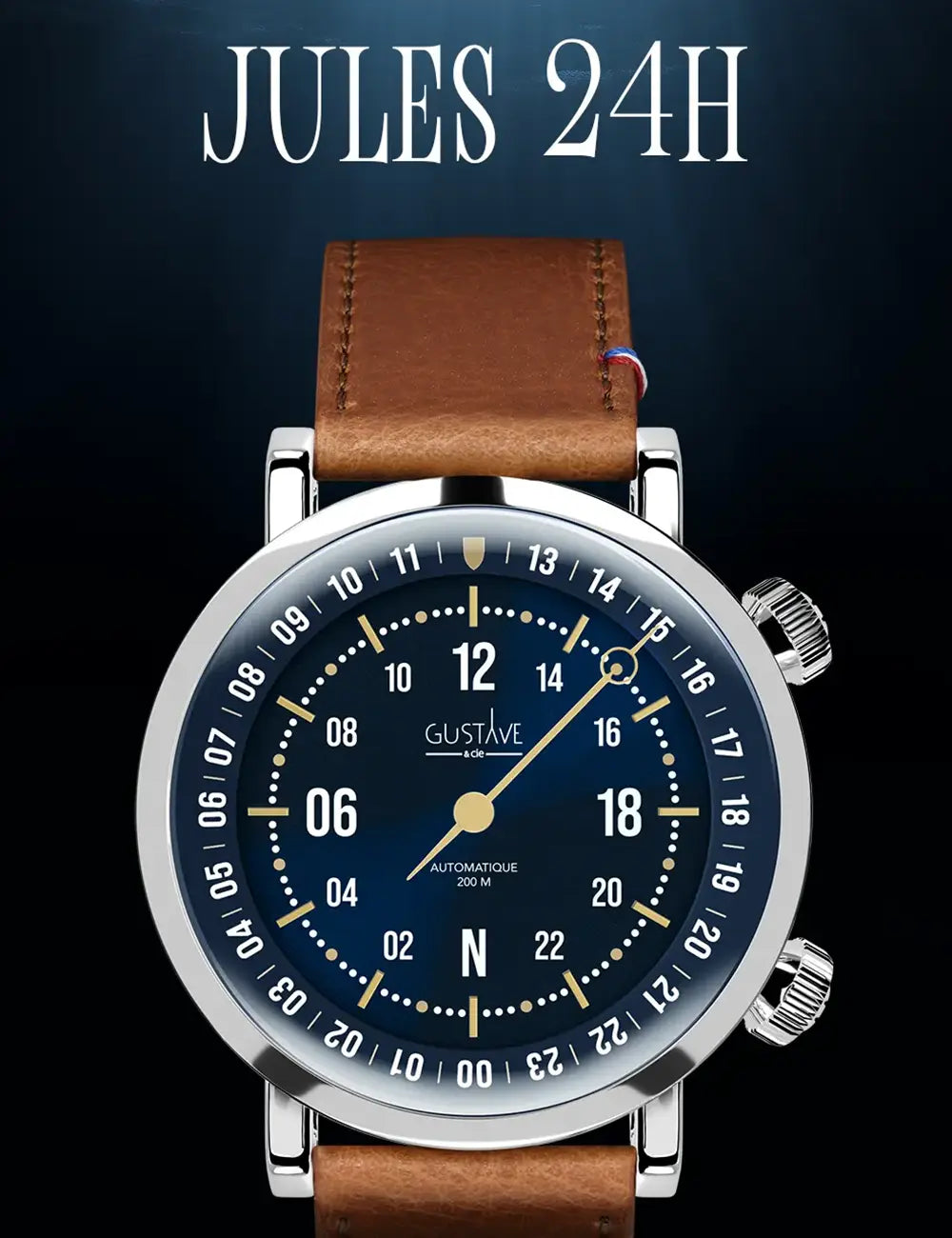
The Gustave & Cie Jules 24H, a 20 ATM water-resistant automatic watch designed to accompany nautical activities and everyday life.
Conclusion
Maintaining and preserving a watch's water resistance is a true ritual of care, guaranteeing the precision and beauty of your timepiece throughout the years. From simply checking the crown before a sea bath to the regular monitoring of the gaskets' health in a workshop, every action counts.
A well-maintained watch is not just a reliable instrument that resists the elements; it is an enduring object, designed to cross through time with elegance and, why not, be passed on to the next generation.
UNDERSTANDING THE DIFFERENT LEVELS OF WATER RESISTANCE IN HOROLOGY
Leave a comment
This site is protected by hCaptcha and the hCaptcha Privacy Policy and Terms of Service apply.