





Taking Time: A Modern Philosophy to Re-enchant Everyday Life
How often do you catch yourself chasing after the hours, juggling overloaded schedules and endless notifications? In our contemporary society, speed has long been elevated to an absolute virtue. We have invented technologies to save precious minutes, secretly hoping to free up space for what truly matters. Yet, the observation is clear: the more we try to save time, the more it seems to slip away from us.
Faced with this paradox, a new form of gentle, hedonistic rebellion is emerging. Taking time is no longer perceived as laziness, but as a true modern philosophy, vital to our balance. It is a return to our roots, an invitation to abandon artificial urgency to rediscover the depth of the present moment.
Knowing how to slow down has become the ultimate luxury of our era. How can we adopt this philosophy on a daily basis? How can we transform our perception of passing hours so we no longer endure them, but savour them? Let us dive together into an art of living that promises to re-enchant your everyday life.
The Urgency of Slowing Down Against the Frantic Pace of Everyday Life
We live in the era of immediacy. Whether it is the delivery of our meals, access to information, or our virtual exchanges, everything is available in a fraction of a second. This culture of instantaneity has profoundly altered our expectations and our biological rhythm. The human mind, though designed for natural cycles of effort and rest, finds itself constantly solicited.
This permanent overstimulation generates an invisible fatigue. The infamous "mental load" does not merely stem from the quantity of tasks to be accomplished, but primarily from the speed at which we demand ourselves to complete them. Modern stress is intrinsically linked to this constant fear of running out of time, missing an opportunity, or not being productive enough.
Taking time thus emerges as a powerful antidote. It is an act of benevolent resistance towards oneself. Consciously deciding not to give in to haste helps lower nervous tension. It gives us back control over our own existence, reminding us that we are not mere executors of an infinite to-do list, but the authors of our own rhythm.
"Slow Life": Much More Than a Trend, an Art of Living
If you are interested in alternative lifestyles, you have undoubtedly heard of the "Slow Life" movement. Born in Italy in the 1980s through "Slow Food", in reaction to the rise of fast food, this concept has now extended to all spheres of existence. From "Slow Travel" to "Slow Fashion", the objective remains the same: prioritising quality over quantity.
The modern philosophy of "Slow" does not mean doing everything in slow motion. Rather, it is about doing things at the right speed. It is the art of dedicating to each activity the time it truly deserves, without letting its tempo be dictated by external imperatives. Preparing a meal with fresh ingredients instead of reheating an industrial dish, choosing to listen to a music album in its entirety rather than frantically skipping from one track to another.
By adopting this posture, our senses awaken. When we take our time, we rediscover the texture of things, the nuances of taste, the depth of a conversation. The hedonistic art of living relies precisely on this mental availability. One cannot appreciate the beauty of a landscape or the complexity of a fine wine if the mind is already turned towards the next appointment.

A break on the terrace of a Parisian café, a symbol of the Parisian art of living and the pleasure of taking the time to slow down.
Changing Our Relationship with the Hour: In Praise of Suspended Time
Our time-measuring tool has a direct influence on how we perceive it. The classic three-hand watch, implacably marking every vanishing second, often maintains this sensation of urgency. The mere act of looking at a dial where three hands are in constant motion can subconsciously provoke a slight spike in stress.
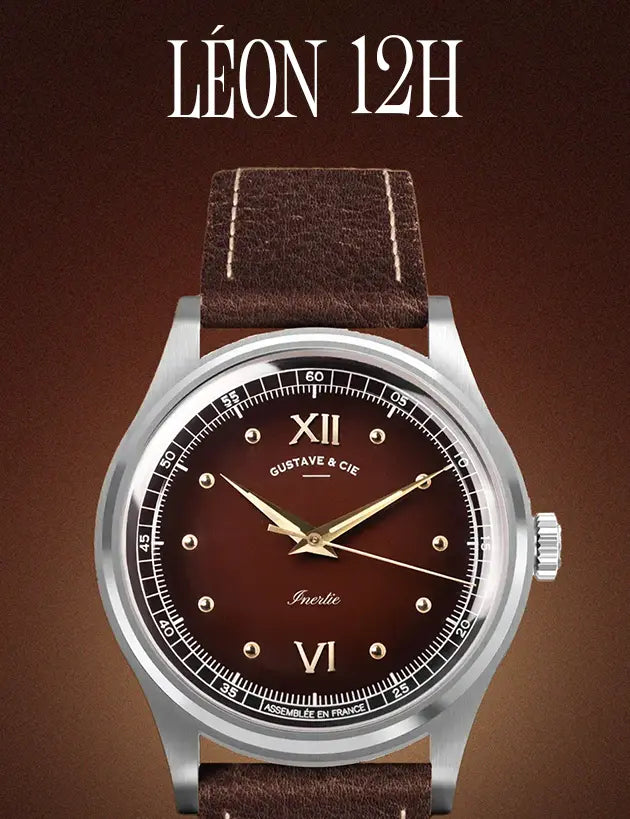
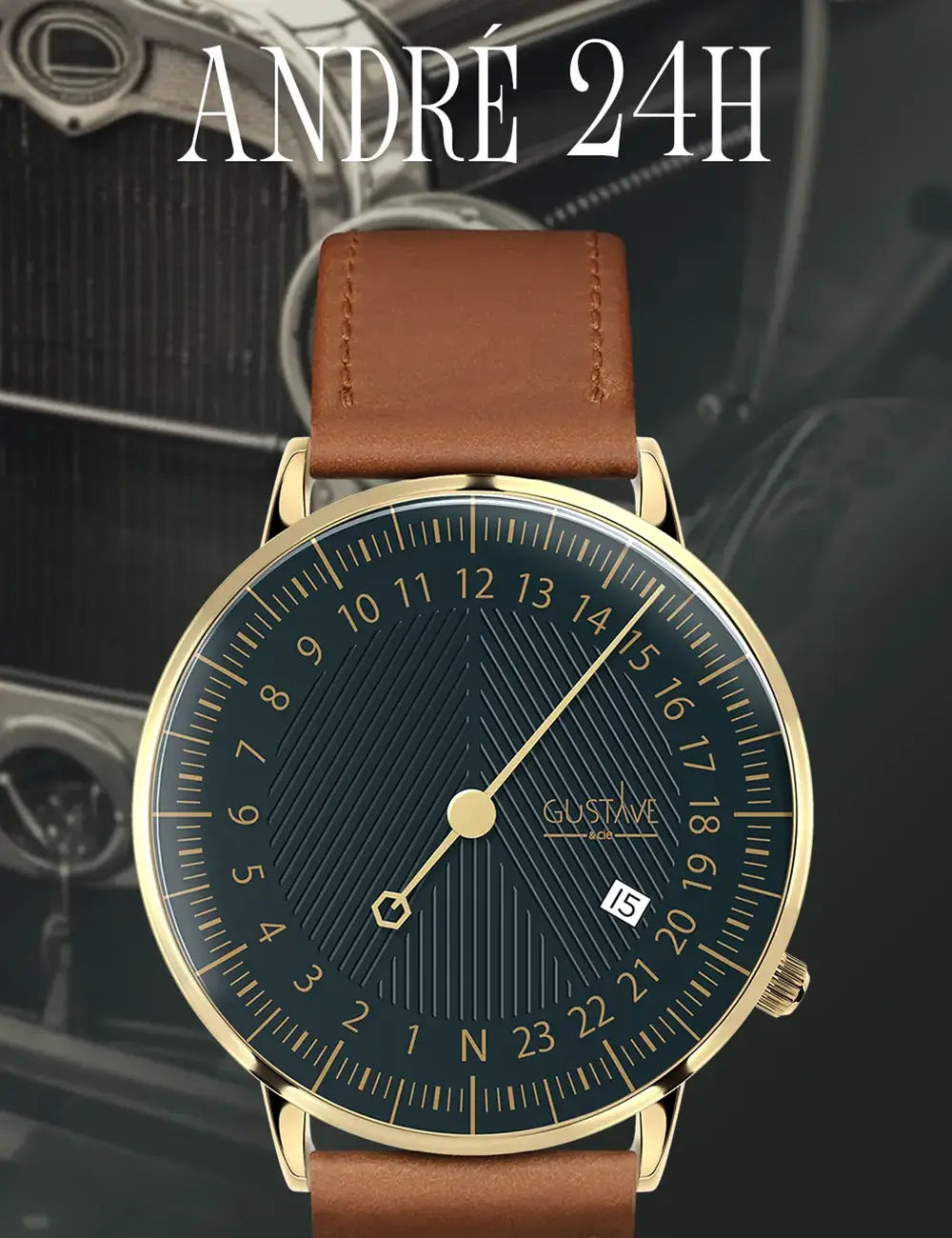
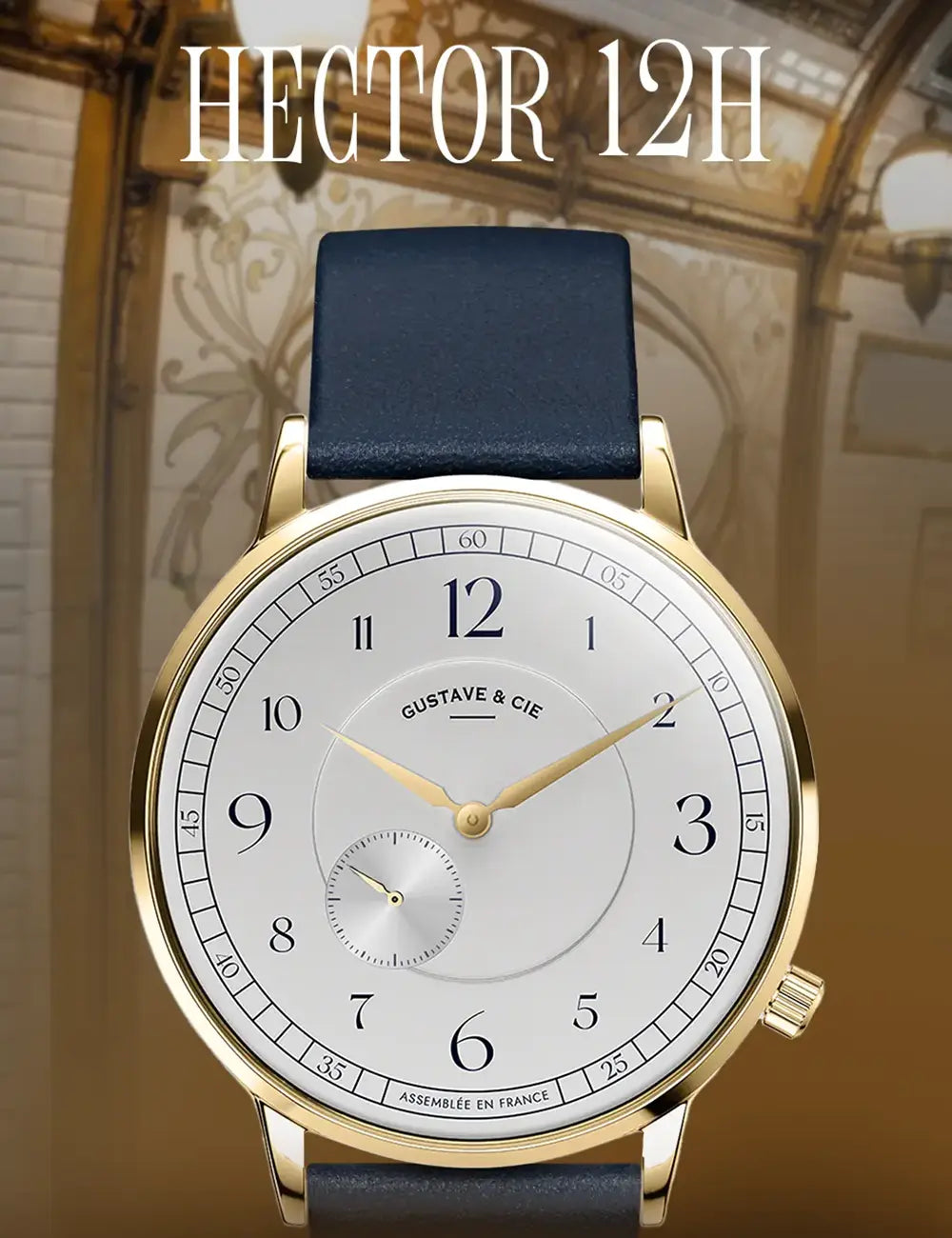
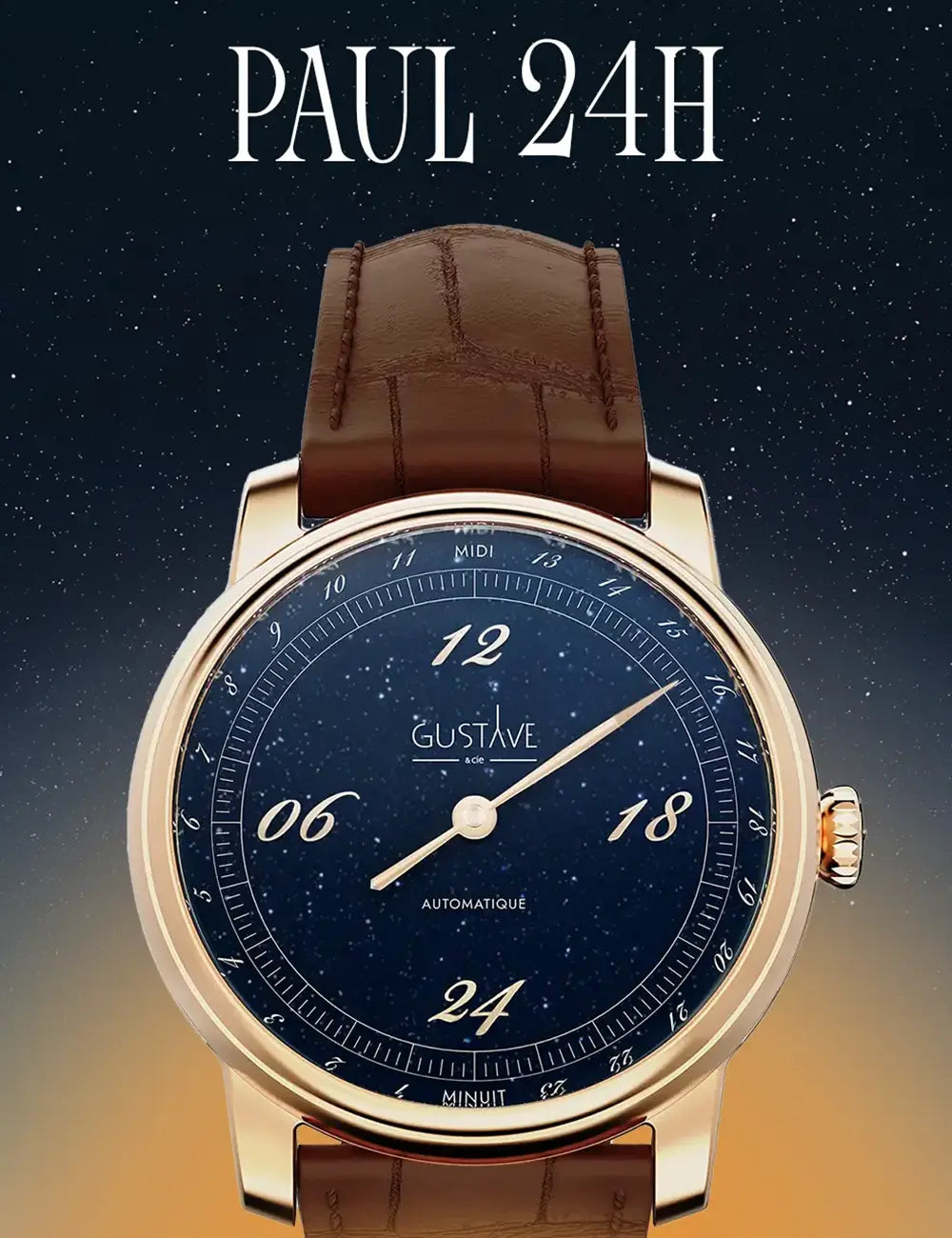
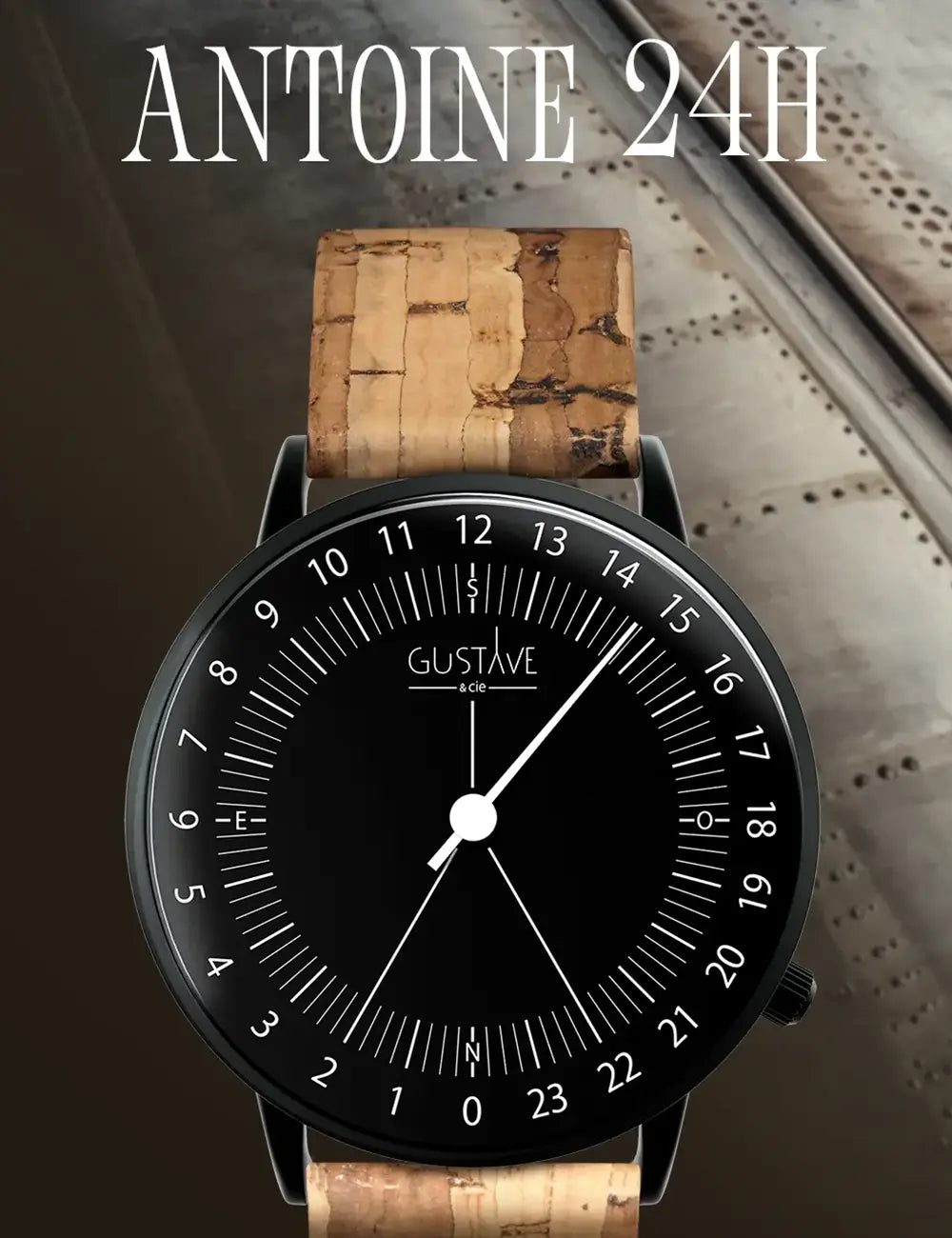
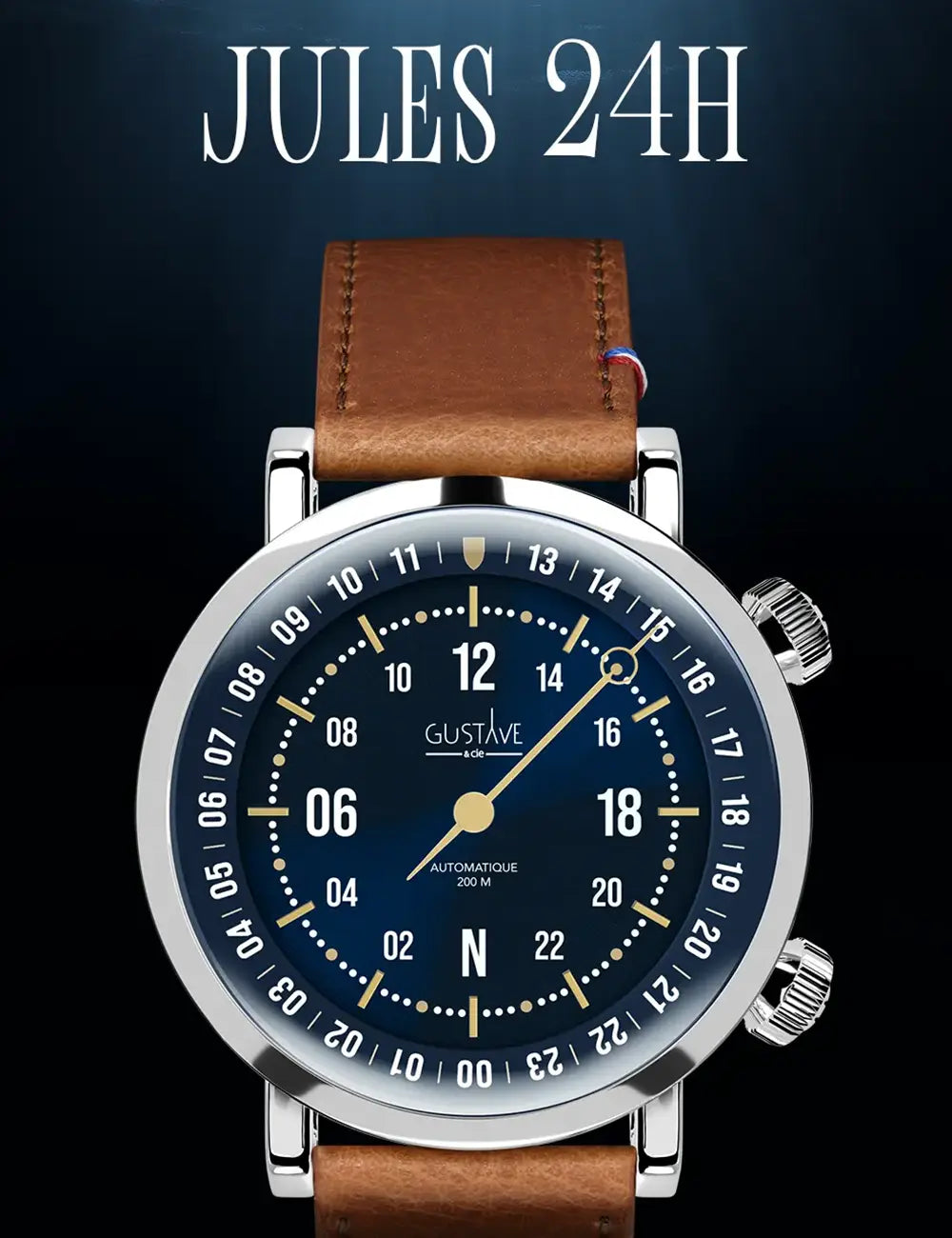
This is where the horological approach takes on its full philosophical meaning. At Gustave & Cie, we deeply believe in the "Slow Time" philosophy. The concept of the single-hand watch on a 24-hour dial is not merely a feat of design or a tribute to the watchmaking of yesteryear; it is a true manifesto for taking one's time.
By eliminating the minute and second hands, time is no longer sliced into minute, anxiety-inducing fractions. It flows smoothly, like the sun across the sky. Reading the time becomes a serene estimation ("it is about 10:15") rather than a precise and stressful countdown. It is an astonishing paradigm shift: by altering our way of reading the dial, we release the pressure and finally allow ourselves to live in the present.
Four Practical Rituals to Cultivate This Modern Philosophy
It is easy to praise the merits of slowness in theory, but how do we apply it in a busy week? Here are four simple habits to integrate into your routine to anchor this modern philosophy in reality.
1. Intentional Disconnection
Establish temporal sanctuaries where screens have no place. Whether it is the first hour after waking up, during family meals, or just before bed. Turning off your phone for even one hour a day cuts off the constant flow of solicitations and restores a mental space conducive to daydreaming.
2. The Art of Strolling
Walk without a specific destination. The art of strolling, dear to poets and writers, is the antithesis of utilitarian travel. Choose to take a longer route home, observe the architecture of buildings, the light filtering through the trees, and let your mind wander to the rhythm of your steps.
3. The Rediscovery of Manual Work
Engage your hands in a concrete activity devoid of any immediate productivity stakes. Gardening, pottery, drawing, or even the meticulous preparation of a slow coffee. Manual work anchors the mind in the material world and demands a soothing concentration that chases away intrusive thoughts.
4. Scheduling "Empty" Time
Stop optimising every corner of your diary. The Dutch concept of "Niksen", which literally consists of doing nothing, proves that idleness is productive for the brain. Sitting on a bench, looking out the window, and simply existing. These white spaces in a schedule are the places where intuition and creativity are born.
Conclusion
Taking time is much more than a simple stress management method; it is a modern philosophy that invites us to redefine our own success. In an era that values speed and hyper-productivity, choosing slowness is a bold move. It is an affirmation that our quality of life is measured not by the number of activities accomplished in a day, but by the depth of presence we grant them.
Life is not a race where the finish line is the setting sun. It is a melody that should be listened to with attention. By changing our relationship with watch hands and cultivating grounding rituals, we can all make this "Slow Life" our new reality. Slow down, breathe, and savour: time belongs to you.
DISCOVER OUR COLLECTION OF 24-HOUR SINGLE-HAND WATCHES

Leave a comment
This site is protected by hCaptcha and the hCaptcha Privacy Policy and Terms of Service apply.