


The Moon Phase: History and Utility of this Horological Complication
Since the dawn of time, man has looked to the heavens to understand his environment and measure the passage of time. Long before the invention of mechanical timepieces, the observation of the stars dictated the rhythm of daily life. Among these celestial landmarks, the lunar cycle holds a prominent place.
Today, bringing this astronomical ballet to the wrist has become a symbol of technical virtuosity. Choosing a moon phase watch is much more than opting for a simple accessory: it is wearing a fragment of the universe. But beyond its undeniable poetry, what is the true history of this complication? How does it work technically, and what is its utility in our hyper-connected world? In this article, we invite you to explore the inner workings of one of the most romantic and fascinating complications in traditional horology.

Moon phase disc: this rotating component, driven by a 59-tooth wheel, allows the lunar cycles to be displayed on the dial.
The Celestial Origins of the Moon Phase Watch
To understand the emergence of the moon phase watch, one must go back to the very beginnings of time measurement. The first clocks were not intended to divide the day into hours and minutes, but rather to replicate the course of the stars. As early as the Renaissance, the astronomical clocks adorning the churches and belfries of Europe proudly displayed the lunar cycles. In an era when agriculture, navigation, and even religious beliefs depended on lunations, this information was absolutely crucial to society.
Integrating this indication into portable formats posed a true technical challenge. It was in the late 19th and early 20th centuries that master watchmakers achieved the feat of miniaturising these complex mechanisms to fit them into pocket watches. The complication then allowed travellers and sailors to predict nocturnal tides or the intensity of moonlight at a mere glance, without relying on cumbersome instruments.
With the advent of the wristwatch in the 1920s and 1930s, the complication achieved true consecration. The great watchmaking manufactures began to offer complete calendars, including the day, month, date, and that famous half-moon aperture where a starry disc revealed the celestial body of the night. This transition from public monument to the intimate wrist profoundly transformed the moon phase: from a scientific tool, it became a showcase of watchmaking expertise and excellence.
How Does the Moon Phase Complication Work?
Behind the poetic elegance of a moon phase watch lies mechanics of great ingenuity. From an astronomical standpoint, a lunation (the complete cycle from one new moon to the next) lasts exactly 29 days, 12 hours, 44 minutes, and 2.8 seconds. Translating this complex fraction into a mechanical gear train demands high-level mathematical precision.
In its most classic form, the complication uses a rotating disc printed with two opposing moons. This disc is driven by a wheel featuring 59 teeth. This number is not chosen at random: it corresponds to two simplified lunar cycles of 29.5 days (29.5 x 2 = 59). Each day, the mechanism advances this wheel by one notch. The aperture, cleverly cut into the dial with its two arcs of a circle, conceals one of the moons while the other makes its slow progression. This faithfully reproduces the moon phases visible from Earth.

Close-up on the movement of a watch: the moon phase disc, driven by a toothed wheel, displays the lunar cycles thanks to its internal mechanism.
Credit : Chopard L.U.C. Calibre L.U.C. 96.13-L https://www.my-watchsite.fr/blog/wp-content/uploads/2022/02/photo1-2.jpg
However, this classic system accumulates a very slight discrepancy over time (approximately 44 minutes per month). It is therefore necessary to manually correct the moon phase by one full day roughly every two and a half years. For purists, some manufactures have developed "astronomical moon phases" using 135-tooth wheels, reducing the mechanical error to one day every 122 years. This quest for precision perfectly illustrates watchmaking's obsession with the absolute mastery of celestial time.
A Historical Utility Turned Aesthetic Signature
Historically, reading the lunation met very practical needs. For sailors, it was essential for anticipating high and low tides, which dictated departures and arrivals in ports. For farmers, it allowed them to structure sowing and harvesting based on nocturnal light and beliefs linked to lunar influence. But today, in the era of smartphones and instantaneous meteorological data, what is the true utility of a moon phase watch?
The utility has mutated. It is no longer strictly functional; it has become emotional, poetic, and identity-driven. Wearing such a complication means displaying an attachment to the grand horological tradition. It is also a soothing philosophical reminder: amidst our schedules fragmented to the precise second, the slow sway of the lunar cycle reconnects us to a long, natural, and universal time.
In terms of design, the moon phase aperture brings an unparalleled visual balance to a dial. It introduces colour (often a deep starry night blue, contrasting with the gold or silver of the celestial body), curvature, and movement into an aesthetic often dominated by the straight rigour of hands and indices. It is a touch of romance that transforms a technical watch into a true work of art on the wrist.
Setting and Maintaining a Moon Phase Watch
Owning such a timepiece requires a certain formalism, particularly when setting it. As the moon mechanism is directly linked to the watch's calendar, it is imperative to avoid what watchmakers call the "danger zone" (generally between 9:00 PM and 3:00 AM). During this period, the gears for the date jump and the moon are engaged; forcing a quick set could irreversibly damage the movement.
To set your watch correctly, the safest method is to position the hands at 6:30, far from the transition zones. Next, it is advisable to find the date of the last full moon on a lunar calendar, set the watch's disc to the full moon (perfectly centred in the aperture), and then advance the mechanism day by day until the current date.
This is where the importance of regular winding comes into play if the watch is not being worn. If your watch is automatic and you leave it aside, it will stop after 36 to 72 hours, depending on its power reserve. You will then have to reset everything and start the tedious process of lunar time-setting all over again. To mitigate this, a delicate manual winding (about twenty turns of the crown) every two or three days is enough to restart the movement and maintain precision. This is why many enthusiasts opt for automatic watch winders, allowing them to preserve timekeeping precision and avoid the desynchronisation of complications like the moon phase.
The Horological Interpretation: The Georges Collection by Gustave & Cie
Although the identity of Gustave & Cie is deeply rooted in the simplicity and philosophy of the 24-hour single-hand, the French brand is above all driven by a global passion for horology. It is with this desire to explore traditions that the Georges collection was born.
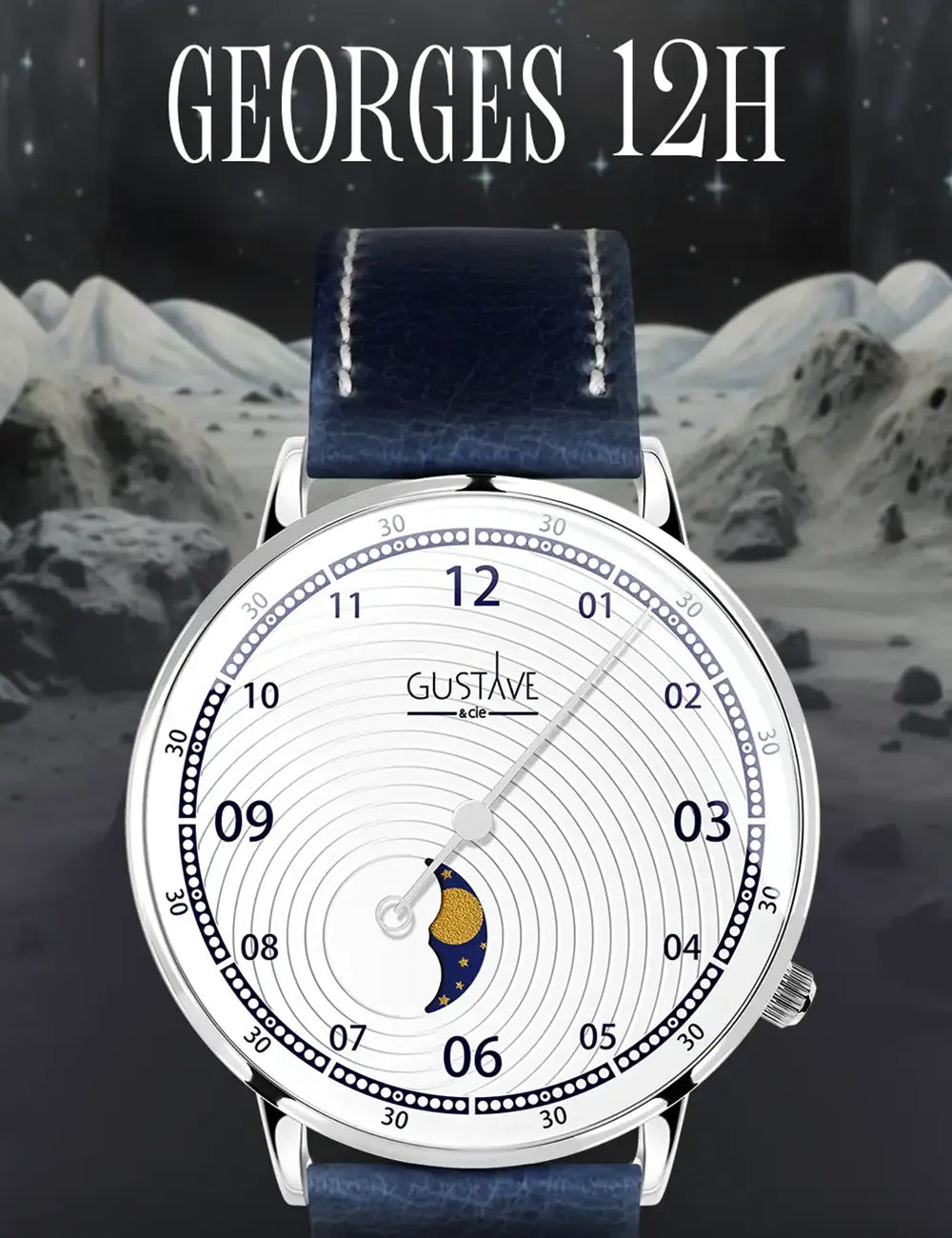
The Georges 12H watch integrates a moon phase complication in a spirit that is both classic and contemporary. Meticulously designed and assembled in France, in Besançon, it pays homage to precision watchmaking while retaining the sleek aesthetic dear to the brand. On this model, the ballet of the nocturnal body sublimes the dial, offering the wearer a permanent spectacle. It is an invitation to contemplate the course of the universe and restore time to its astronomical dimension.

The Georges collection by Gustave & Cie: two moon phase watch models, available in blue and white dials, worn on the wrist.
Conclusion
Ultimately, the moon phase watch perfectly illustrates what makes horology so captivating. It is the exact meeting point between the mathematical rigour of metal gears and the elusive poetry of astronomy. While its primary utility has faded in favour of modern technology, its symbolic value has never been so powerful. It subtly reminds us that time is not just a simple succession of numbers on a screen, but rather the perpetual dance of the stars above our heads. Wearing the universe on one's wrist remains the timeless privilege of aesthetes and enthusiasts.
Discover our Georges collection and let yourself be seduced by the elegance of the moon phase

Leave a comment
This site is protected by hCaptcha and the hCaptcha Privacy Policy and Terms of Service apply.