


From Design to Prototype: The Creation of a Gustave & Cie Watch
The creation of a Gustave & Cie watch is a fascinating journey, a meticulous process requiring months of reflection, testing, and fine-tuning. It is not simply a matter of designing a dial and assembling hands on it. It is a true quest for meaning, aesthetics, and technical excellence, always guided by our desire to champion French craftsmanship.
Today, we open the doors of our design studio to you. From the initial historical research to the validation of the very last physical prototype, discover the fascinating behind-the-scenes of the birth of a Gustave & Cie watch.
Telling a Story and Paying Tribute
Every creation at Gustave & Cie begins with a desire to tell a story. We do not design watches for the simple pleasure of launching a new product; we create timepieces to pass on a legacy. The very identity of our Maison rests on a strong concept: paying tribute to illustrious French figures who have marked their era through their genius, their audacity, or their vision.
Whether in literature, science, exploration, or poetry, we first look for a figure who deeply inspires us. This choice is never dictated by chance. It is the fruit of our readings, our cultural discoveries, and our emotional resonance with the journey of an exceptional man or woman.
Once this personality is chosen, they become the muse for our future collection. We immerse ourselves in their universe: what were their values? What was their relationship with time? What inventions or major works did they leave as a legacy? This immersion stage is crucial. It guarantees that the watch will not just be a simple measuring instrument, but an object with a soul, capable of evoking emotion in the person who wears it or receives it as a gift. Offering a Gustave & Cie watch is thus offering a fragment of history, an intimate piece that bridges the past and the present.
Seeking Inspiration: Shapes, Eras, and Aesthetic Codes
Once the story is defined and our muse chosen, the real work of aesthetic exploration begins. How do you translate the life of a 19th-century inventor or the audacity of a Roaring Twenties artist into a contemporary horological design? This is where visual inspiration research comes in.
We review a multitude of references. We analyse the horological trends of the era corresponding to our personality: the pure, modernist lines of the 60s, the geometric boldness of the 80s, or the classic elegance of early-century pocket watches. But our inspiration does not stop at watches. We study the architecture, art, everyday objects, fashion, and colours that defined the targeted era.
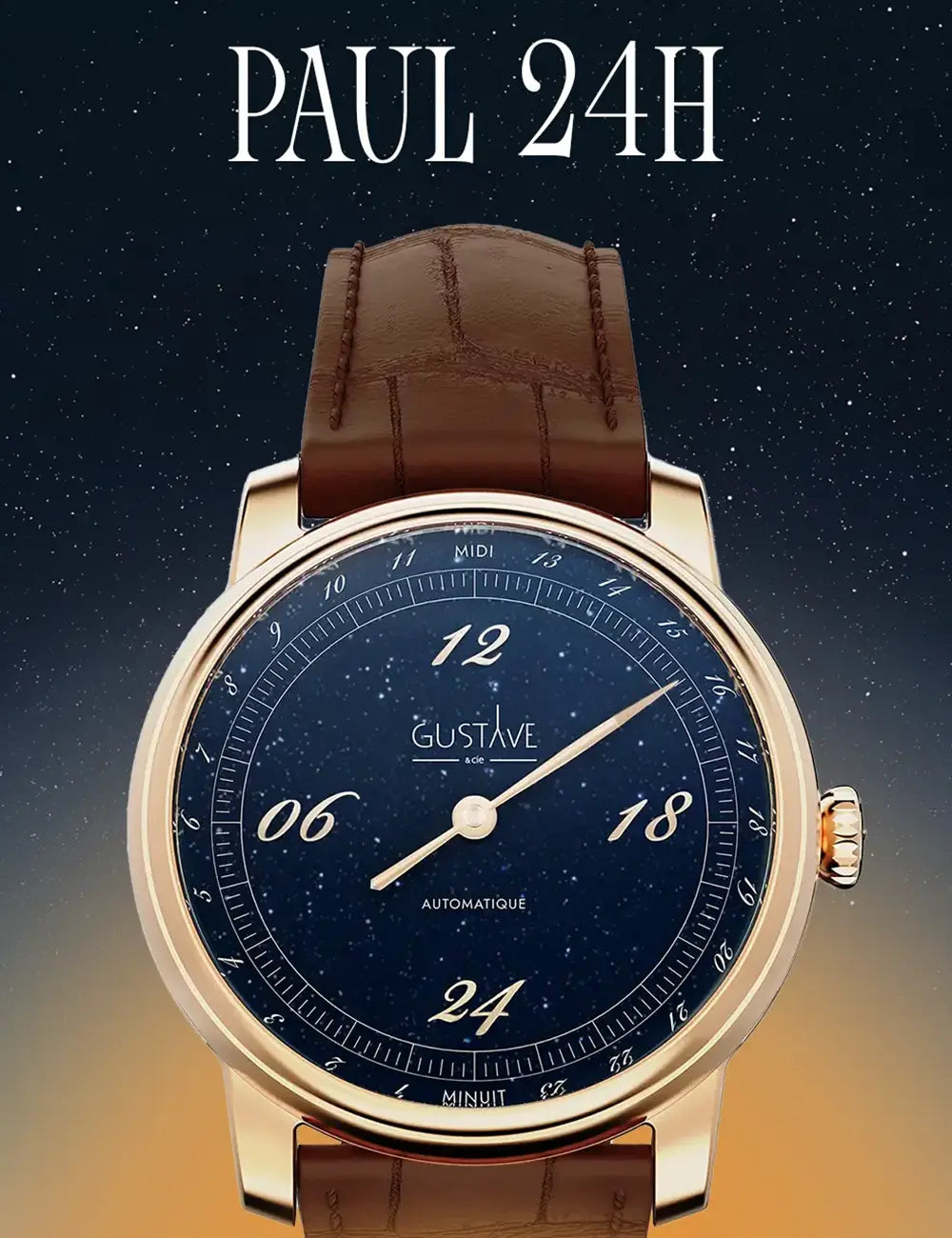
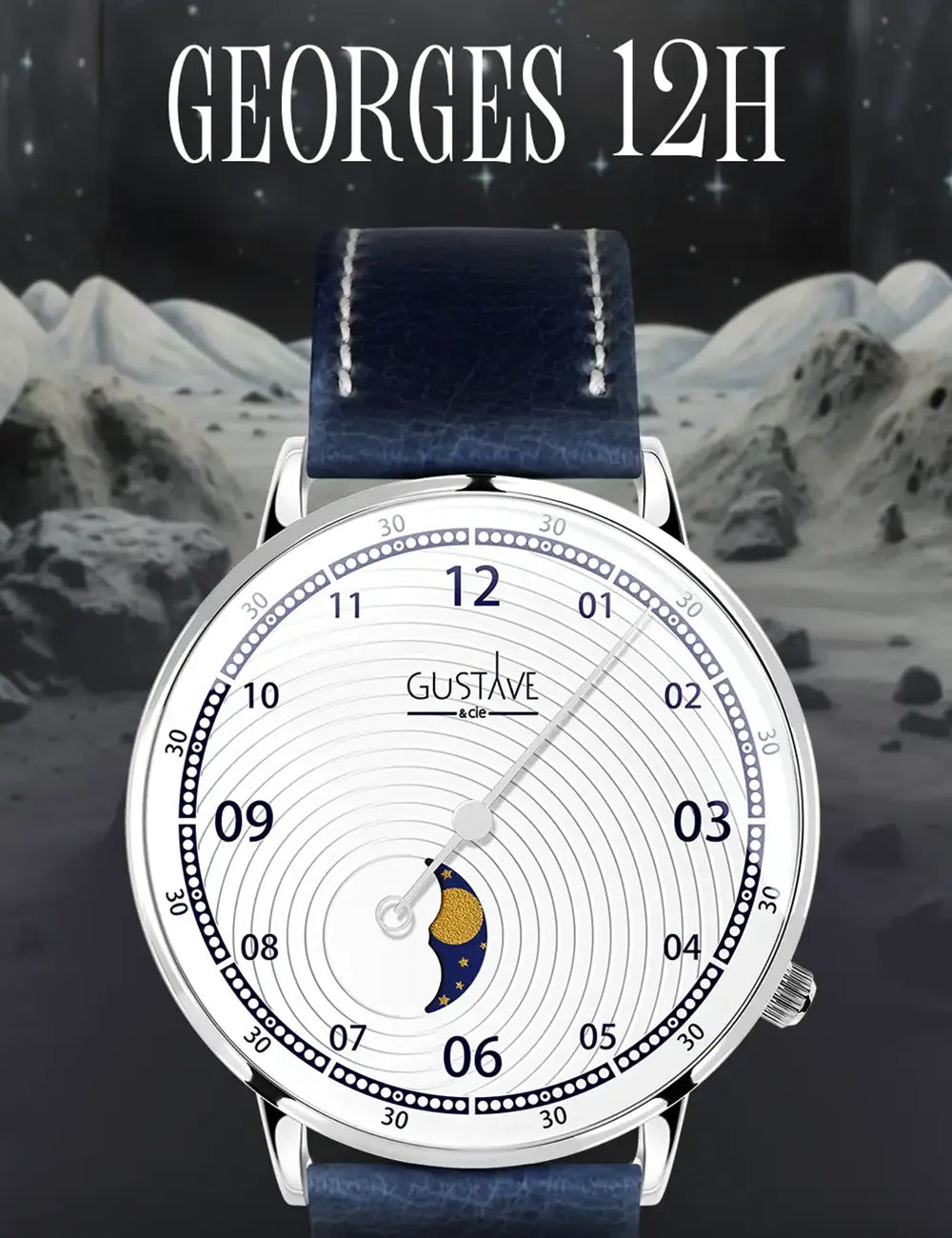
Every detail counts. If we are paying tribute to a scientist specialising in light or astronomy, we will naturally gravitate towards specific complications, such as a moon phase display, or play with the luminescence of the indices (notably thanks to Luminova technology, which is essential for elegant nocturnal readability).
From the Moodboard to the First Pencil Sketches
All these researches, images, textures, and colours are then gathered to create what we call a "moodboard". This grand visual collage becomes our compass. It defines the overall atmosphere of the future watch, its energy, its warmth or coldness, its classicism or modernity.
It is from this moodboard that we pick up our pencils. The first sketches are often prolific, free, and instinctive. We outline dozens of case profiles, imagine typographies for the dial numerals, and draw the precise shape of that famous single-hand, the emblematic signature of Gustave & Cie.
Gradually, the aesthetic direction is refined. We proceed by elimination, keeping only the drawings that respect two fundamental criteria: visual harmony and absolute fidelity to our DNA. Because beyond the tribute, the watch must intrinsically remain a Gustave & Cie. It must invite that famous peaceful reading of time, often materialised by our 12-hour or 24-hour single-hand system, and display that sleek elegance which characterises the singularity of our Maison.

Preparatory drawings and sketches of the Paul 24H collection highlighting the design work on the case, indices, crown, and unique hand.
Technical Choices: Materials, Movements, and Horological DNA
Design is nothing without technique. Once the overall aesthetic is validated on paper, a decisive stage begins: translating this drawing into real horological constraints. We must marry the poetry of design with the rigour of mechanics.
We conduct an in-depth reflection on the choice of movement. Depending on the collection's positioning, we opt for reliable and precise quartz calibres, or for the timeless nobility of automatic movements (12h or 24h), which come to life with the rhythm of the wearer's wrist movements. This mechanical choice directly influences the thickness of the case and the design of the dial.
Next comes the selection of materials. To guarantee flawless durability, which will make this watch a gift capable of crossing decades, we study the best stainless steel alloys. We define the finishes: polished steel for sophisticated brilliance, brushed steel for a rawer, more contemporary look, or PVD (Physical Vapour Deposition) treatments to achieve deep black, gold, or copper tones of extreme resistance.
We also select the glass quality (sapphire or hardened mineral), the required water resistance, and the nature of the straps, whether they are in eco-friendly vegetable-tanned leather, Milanese mesh, or fabric. Each of these technical choices is guided by our unwavering desire to maintain impeccable quality, while preparing the ground for the final assembly in France a non-negotiable step in our specifications.
The Magic of 3D: Visualising the Future Watch
The 2D sketches and technical specifications are ready. It is time to give volume to our idea. We then move on to 3D CAD (Computer-Aided Design) modelling. This technological step is absolutely fascinating, as it allows us to see the watch come to life from all angles before it even physically exists.
The 3D model allows us to refine proportions to the nearest tenth of a millimetre. We check the curvature of the lugs to ensure they will perfectly hug the wrist, guaranteeing optimal wearing comfort. We virtually simulate the play of light on a sunray or matte dial, and we adjust the height of the hand so that it passes delicately over the applied indices without ever touching the glass.
This digital mockup is also essential for visualising the different variations of the same collection. We can digitally test the combination of a rose gold case with a midnight blue dial, or the effect of a camel leather strap on a black steel case. 3D is a boundless laboratory of experimentation that saves us precious time and ensures we have found the perfect balance before launching physical manufacturing.

Initial 3D models of the Paul 24H collection used to visualise the proportions, design, and details of the timepiece.

Final 3D modelling of the Paul 24H collection incorporating the final finishes and tweaks before the production phase.
Prototyping: When the Idea Becomes a Physical Reality
Despite all the precision of 3D modelling, nothing replaces physical contact. The final stage, and undoubtedly the most moving of this long journey, is prototyping. Using our 3D files and technical blueprints, our partners machine, polish, paint, and assemble the very first real version of the watch.
When we receive this first prototype in our offices, it is always a breathtaking moment. It is the confrontation of the idea with reality. We put the watch through the sieve of our requirements. We hold it in our hands to evaluate its weight. We place it on our wrist to judge its ergonomics and presence.
We meticulously check if the colour of the dial exactly matches what we had imagined: is it the right deep blue? Is the sandblasted texture subtle enough? Is the hand perfectly legible at a glance, faithful to our promise of Slow Time? Does the PVD treatment reflect light as expected?
Very often, the first prototype requires adjustments. A slightly too prominent lug, a dial shade just a fraction too light, a winding crown that lacks grip under the fingers... We note every detail to improve. We then launch a second prototype, sometimes a third, or even a fourth. We iterate until we obtain exactly the desired result, that aesthetic and mechanical perfection that will make us proud.
It is only once the ultimate prototype is validated, the one that is unanimously approved by the team and fully respects our vision, that we give the green light for final production and begin preparing the communication to unveil it to you.

Following the various prototyping stages and the validation of the final model, the assembly of the watch begins ahead of its launch.
Conclusion
The creation of a Gustave & Cie watch is a long and demanding journey, standing at the crossroads of art, history, and micro-mechanics. From the initial burst of inspiration born from the journey of a great French figure to the elaboration of the prototypes, each step is driven by the same passion: giving meaning to the passing of time.
This meticulous process, the assembly in France, and this patiently refined design are the guarantee that the object you will wear on your wrist is not just a simple accessory. It is the fruit of a human adventure, a condensation of emotions and expertise. This is why a Gustave & Cie watch transcends its primary function; it becomes a gift to give or to treat oneself with, to celebrate a milestone in life, and to live at one's own pace.
DISCOVER OUR WATCHES ASSEMBLED IN FRANCE
Leave a comment
This site is protected by hCaptcha and the hCaptcha Privacy Policy and Terms of Service apply.