


The Moon Phase Complication: Between Astronomy and Poetry
Before dictating our days using computer servers and digitised time zones, our only true reference was celestial. While the course of the sun has always defined the daily cycle, it is the star of the night that offered early civilisations their very first long-term calendar. The moon, with its immutable cycles, has guided sailors, set the rhythm for harvests, and inspired the greatest artists.
Today, watchmaking perpetuates this ancestral bond between man and the cosmos. Wearing a moon phase complication no longer answers a strict need for survival or navigation, but rather a quest for elegance and meaning. At the perfect intersection of mechanical rigour and pure emotion, this function remains as fascinating as ever.
What is a moon phase complication?
In traditional horological vocabulary, a "complication" refers to any additional function added to a watch, beyond the basic display of hours, minutes, and seconds. The chronograph, the date (quantième), or even the alarm are part of this. The moon phase complication, for its part, has the mission of mechanically reproducing the lunar cycle as we observe it from Earth.
This cycle, called the synodic month, lasts precisely 29 days, 12 hours, 44 minutes, and 2.9 seconds. It is the time required for the moon to complete a full revolution around our planet and return to the same position relative to the sun and the Earth. To transpose this astronomical reality to the scale of a watch movement, engineers and watchmakers had to demonstrate great ingenuity.
Technically, the mechanism most often relies on a disc hidden beneath the dial. This disc is illustrated with two identical moons, often printed or applied onto a starry vault. It is driven by a specific toothed wheel, which advances by one notch each day.
Above this disc, the dial is pierced with a softly shaped opening, known as an aperture (or guichet). It is the specific cut-out of this aperture, often in the shape of a semicircle with two inverted arcs, that allows the celestial body to be progressively masked or revealed. Thus, day after day, one observes the passage from the new moon (invisible), to the first quarter, up to the full moon, before waning towards the last quarter.


Poetry on the wrist: an ode to "Slow Time" and emotion
In an era where our smartphones inform us of the exact time down to the millisecond and vibrate with every notification, why burden oneself with a lunar indicator? The answer lies in one word: poetry. The moon phase complication is undoubtedly the most romantic function in modern watchmaking.
It invites us to slow down, to embrace the philosophy of "Slow Time". Observing a small disc perform an imperceptible rotation that will take nearly a month to complete is a true lesson in patience. It is a discreet reminder, fastened to your wrist, that despite the urgency of our daily lives, we belong to a solar system governed by slow, calm, and immutable rhythms.
Beyond a personal approach, the moon phase carries with it an incomparable emotional dimension when given as a gift. It is a way of marking an important moment in life with an object endowed with a soul, a history, and a connection with nature. The watch becomes a touch of elegance and refinement.
The Georges collection: Gustave & Cie's tribute to cinema and space
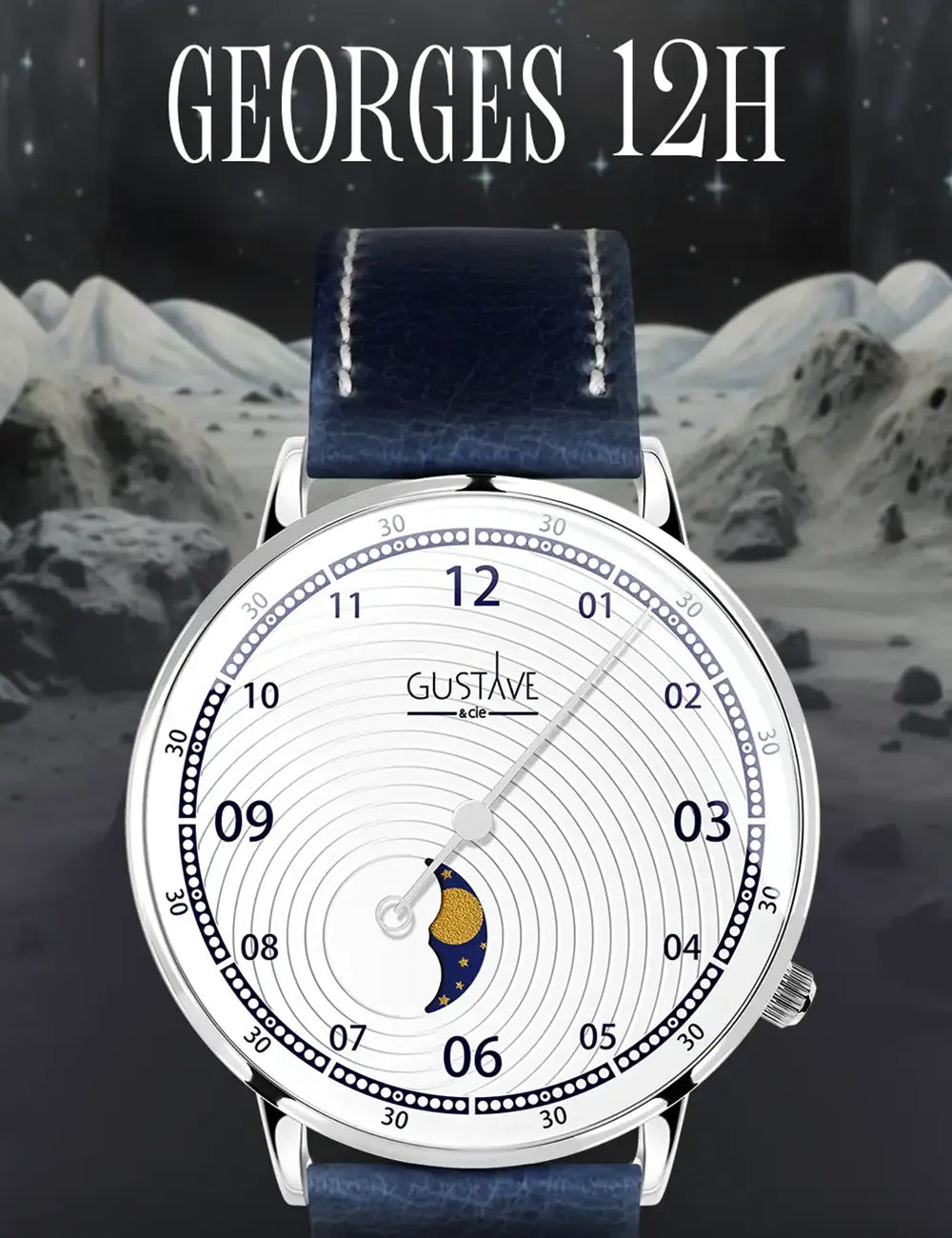
At Gustave & Cie, we wished to capture this magic through a creation that reflects who we are, proudly assembled in France. Thus, the Georges collection was born. This model pays tribute to Georges Méliès, the illustrious Parisian director and brilliant illusionist, who laid the foundations for special effects and modern cinema.
In 1902, Méliès directed the very first science-fiction film in history, the French masterpiece A Trip to the Moon (Le Voyage dans la Lune). In a scene that has become universally iconic, a space capsule is seen crashing directly into the eye of a moon with a human face. It seemed obvious to us to associate this pioneer of dreams with a watch featuring a moon phase complication.
Find out more about the history of Georges Méliès' film "A Trip to the Moon".
Source : scifi-movies
The Georges watch is a concentrate of design and poetry. It adopts the 12-hour single-hand format dear to our house, where each index represents a five-minute interval, thus fostering a serene reading of time. At the centre of this dial, a delicate embossing of concentric circles evokes planetary orbits.
The whole is protected by a domed sapphire crystal. This choice of material does more than merely offer scratch resistance; its curvature directly echoes that of the lunar body, accentuating the depth of the dial. Powered by a highly reliable Japanese Miyota quartz movement, this watch, 36 or 40 mm in diameter, brings together technical precision and dreamlike escapism.

How to set and care for your Gustave & Cie moon phase watch?
While contemplating the moon is a gentle activity, setting it on a watch requires a small mechanical interaction that will delight lovers of beautiful objects. The quartz movement of our Georges collection greatly simplifies daily use compared to a mechanical movement that would stop after a few days of inactivity, but it is important to know the correct handling.
To set the standard time, you simply need to pull the crown out completely, to the second click, turn the single hand, and then push it back in. The setting of the moon phase complication, on the other hand, is done on the first click.
By pulling the crown to the halfway point (first click) and turning it upwards, you will scroll through the lunar disc. The simplest trick is to consult an official lunar calendar online and turn the crown until the moon displayed on your watch matches the one indicated on the site.
Consult the lunar calendar.
Source : calendrier-lunaire
In terms of maintenance, your Georges watch is designed to accompany you with complete peace of mind. It boasts a water resistance of 5 ATM, which protects it from everyday splashes, hand washing, and rain. You should simply avoid submerging it completely underwater. The battery of its quartz movement offers a lifespan of approximately two years, easily replaceable at any watchmaker, ensuring you never lose track of stellar time.
A celestial anchor for the everyday
Choosing a watch equipped with a moon phase complication means rejecting the banality of a purely functional reading of time. It means agreeing to wear on your wrist a mechanism that tells a story that of astronomy's pioneers, intrepid navigators, and visionary directors.
At Gustave & Cie, we believe that watchmaking is above all a source of emotion. From design to assembly in our Besançon workshops, every detail is crafted with care. By slowing down your perception of the hours thanks to the single hand, and by observing the lunations pass peacefully, you no longer simply read the time: you take the time to live it.
DISCOVER OUR GEORGES 12H COLLECTION

Leave a comment
This site is protected by hCaptcha and the hCaptcha Privacy Policy and Terms of Service apply.