



Jules Verne: Visionary of Time and Extraordinary Voyages
The history of literature is replete with authors fascinated by the exploration of unknown lands or distant spaces. However, few have managed to capture the very essence of time with as much virtuosity as Jules Verne. At the dawn of the Industrial Revolution, as the world accelerated to the rhythm of steam trains and telegraphs, this French writer made time the guiding thread of his anticipatory tales. More than a simple novelist, Jules Verne established himself as a true watchmaker of the imagination. He arranged his plots with the meticulousness and precision of a perfectly assembled mechanical movement.
In the Extraordinary Voyages, time is never a passive or secondary element. It is counted, measured, boldly defied, and, at times, it even saves the lives of his famous protagonists in extremis. Whether racing across the globe, exploring the dark oceanic abysses, or aiming for the orbit of the stars, each expedition relies on an absolute mastery of chronometry

Jules Verne, the writer at work, at his writing desk.
This article invites you to delve into the very cogs of Verne’s masterpieces. Together, we shall discover how Jules Verne’s obsession with time not only shaped his novels but also anticipated our modern relationship with punctuality, time zones, and global exploration.
Time, the True Hero of Around the World in Eighty Days
Among Jules Verne's immense bibliography, Around the World in Eighty Days is undoubtedly the novel where time plays the leading role. From the very first pages, the character of Phileas Fogg is presented not as a fiery adventurer, but as a man regulated like a high-precision clock. His daily habits, the number of his steps, and even his rare silences are meticulously timed.
Fogg is the personification of British exactitude and the nascent industrial era. For this gentleman, the world is no longer a vast, wild, and unpredictable expanse filled with impenetrable mysteries. It has become a measurable geometric space that can be traversed in a mathematically defined number of days according to the schedules of transport companies. His most precious tool is neither a compass nor a pistol, but his faithful pocket watch, a horological instrument he consults with an almost obsessive regularity.
Throughout the novel, each stage of the journey transforms into a relentless struggle against the inexorably turning hands of the dial. Unforeseen delays of steamships, train breakdowns in the middle of India, and natural obstacles are all grains of sand threatening to jam the mechanism of his audacious wager. The suspense of the entire work rests on this permanent horological tension. Jules Verne thus proves that time, far more than the distance in kilometres, is the true adversary of the modern traveller.
Marine Chronometers and Navigation in Jules Verne's Work
While Phileas Fogg strides across dry land with his pocket watch as his sole temporal guide, Captain Nemo, the emblematic and shadowy figure of Twenty Thousand Leagues Under the Sea, reigns over the oceans thanks to instruments of fascinating complexity. Within the hushed cabin of the Nautilus submarine, surrounded by masterpieces of art and marvels of science, marine chronometers occupy a place of paramount importance.
Jules Verne possessed a sharp scientific culture and a profound understanding of the maritime navigation challenges of his time. Since the 18th century and the inventions of British watchmaker John Harrison, the scientific world knew that determining longitude on the high seas depended entirely on the precision of an onboard clock. Without a chronometer capable of withstanding the violent rolling of the waves, extreme temperature variations, and saline humidity, it was technically impossible to know one's exact position on the ocean.

A historical timepiece: John Harrison's marine chronometer (1759), a masterpiece that revolutionised the art of navigation.
Nemo, a solitary savant and sovereign of the waves, possesses chronometers of absolute perfection, allowing him to navigate the abysses without ever losing his spatial and temporal bearings. The submarine itself functions like an immense, autonomous, and waterproof watch. In this enclosed environment, each crew member performs their task according to an immutable ritual dictated by the measurement of time. The insistent presence of these instruments in Verne’s descriptions underscores a fundamental truth: mastering one's environment requires, above all, mastering one's time.
The Conquest of Space: A Matter of Perfect Synchronisation
Long before the first human truly set foot on our satellite, Jules Verne had already imagined the ballistic and temporal details of such a journey in his novel From the Earth to the Moon. In this pioneering work, horology leaves the surface of the terrestrial globe to engage directly with celestial mechanics. The titanic enterprise of the Baltimore Gun Club rests not only on the colossal power of gunpowder but on absolutely perfect mathematical synchronisation.
For the manned projectile to successfully cross the lunar orbit, the launch window is calculated with draconian precision. The departure of the craft must occur at a precise instant 'T', defined by the seasoned astronomers of the Cambridge Observatory. A delay of a mere fraction of a second during ignition, and the projectile would wander forever in the sidereal void, fatally missing its target.

Period illustration from Around the Moon, illustrating the visionary space journey imagined by Jules Verne.
In these pages, Jules Verne masterfully illustrates the vital importance of coordinating times and clocks. During this 19th-century era, the electric telegraph was just beginning to allow the transmission of the exact time over long distances. The author pushes this technological concept to its climax. He unites the complex sciences of astronomy, ballistics, and fine horology in a breathless cosmic ballet. This narrative tension strikingly foreshadows the televised countdowns of the Apollo missions a century later.
The Fascinating Mystery of the International Date Line
One of the most famous and brilliant plot twists in the history of literature lies in the unexpected denouement of Around the World in Eighty Days. Just as Phileas Fogg believes himself ruined and dishonoured, intimately convinced that he has exceeded the absolute deadline set for his wager, a miracle occurs. His faithful servant Passepartout discovers, upon visiting a reverend, that they are actually twenty-four hours ahead of their calendar.
This masterful literary twist relies entirely on a very real astronomical and geographical phenomenon: the famous International Date Line. By continuously travelling eastwards, Phileas Fogg was moving towards the sun. Consequently, he saw the sun rise eighty times during his journey, while the members of the London Reform Club who remained behind only saw it rise seventy-nine times.
Jules Verne uses the very rotation of the Earth here as a gigantic and infallible clockwork movement. He brilliantly educates his readers on the relativity of local time compared to universal time. At the time of the novel's publication in 1872, the International Meridian Conference in Washington, which would officially establish the Greenwich meridian as the global reference, had not yet taken place. Verne was therefore singularly ahead of his time, raising public awareness of the need to divide the world into twenty-four distinct time zones.
A Visionary's Legacy for Modern Explorers
Today, Jules Verne's intellectual legacy still resonates very powerfully, both in popular culture and in our pragmatic relationship with time and travel. The French writer taught us that the world is a wondrous playground, provided we know how to read, respect, and understand the hours ticking away on our dial. His novels have shaped the imagination of entire generations of scientists, engineers, and adventurers.
Nowadays, crossing multiple time zones in a few hours has become commonplace thanks to modern civil aviation. Yet, the thrill of the Vernian adventure endures among all those who continue to explore the globe with passion and curiosity. This unconditional love of global geography has, moreover, profoundly influenced the world of contemporary horology. Specific horological complications have emerged to meet the needs of these modern nomads.
To go further : Article about the Worldtimer complication and modern travel watches
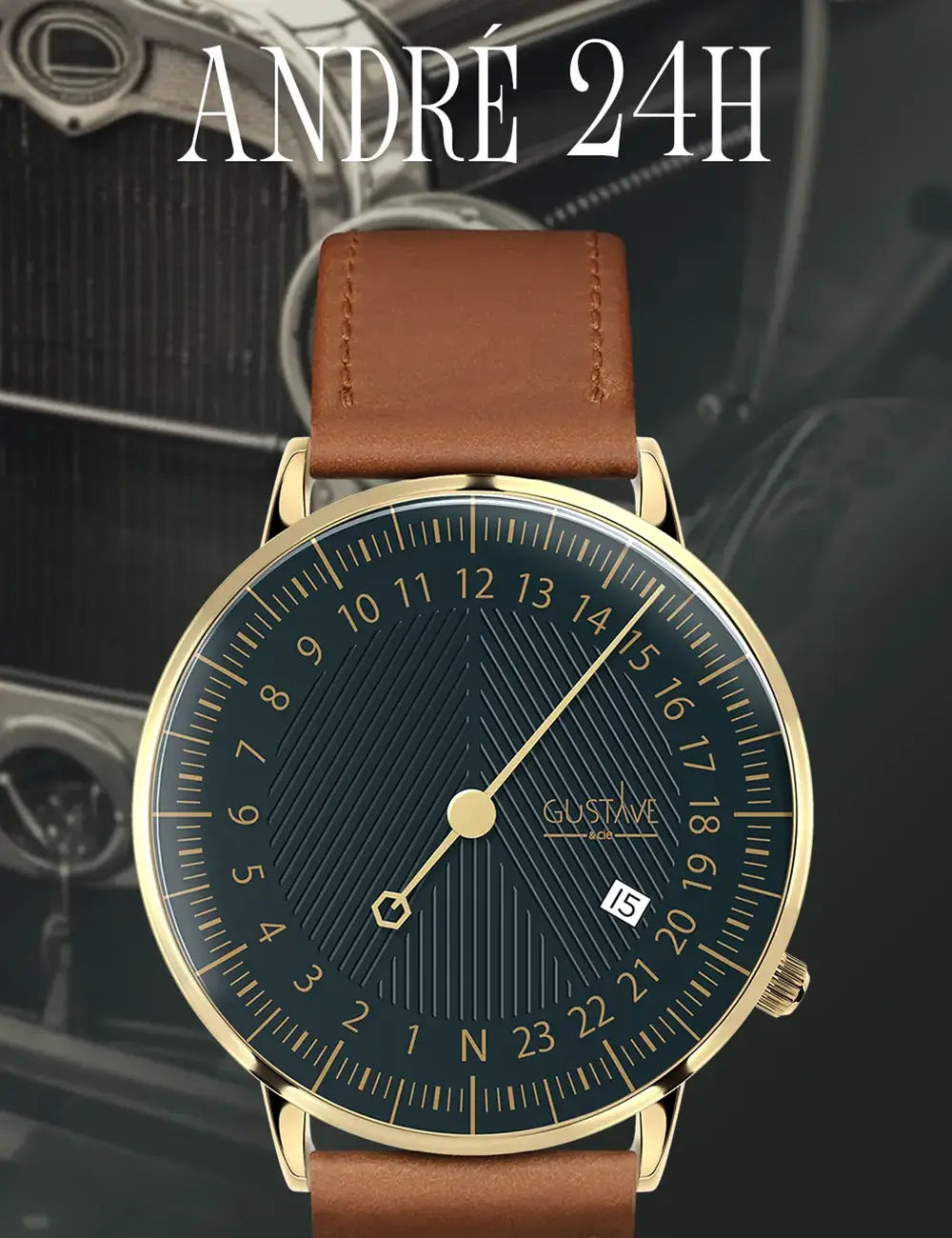
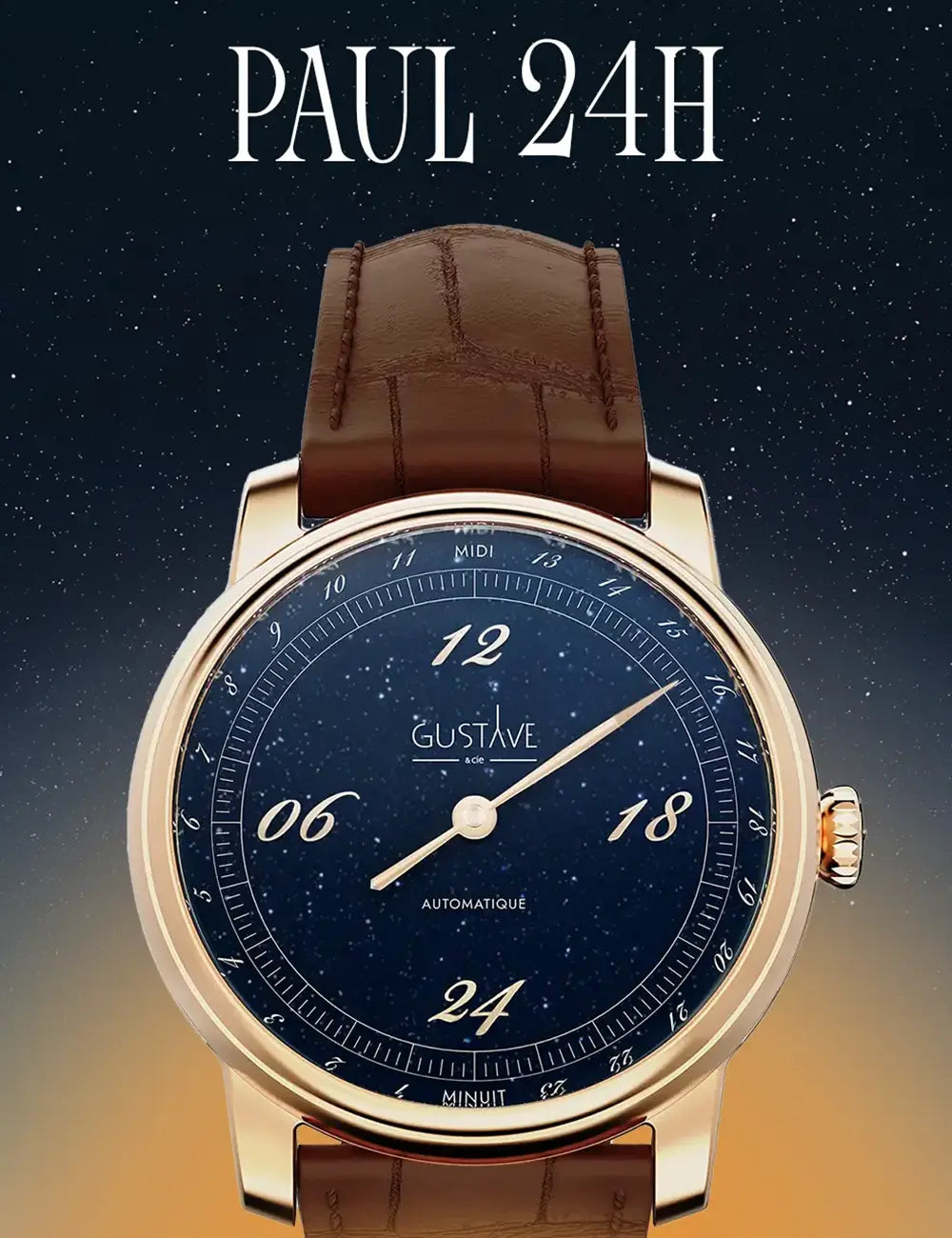
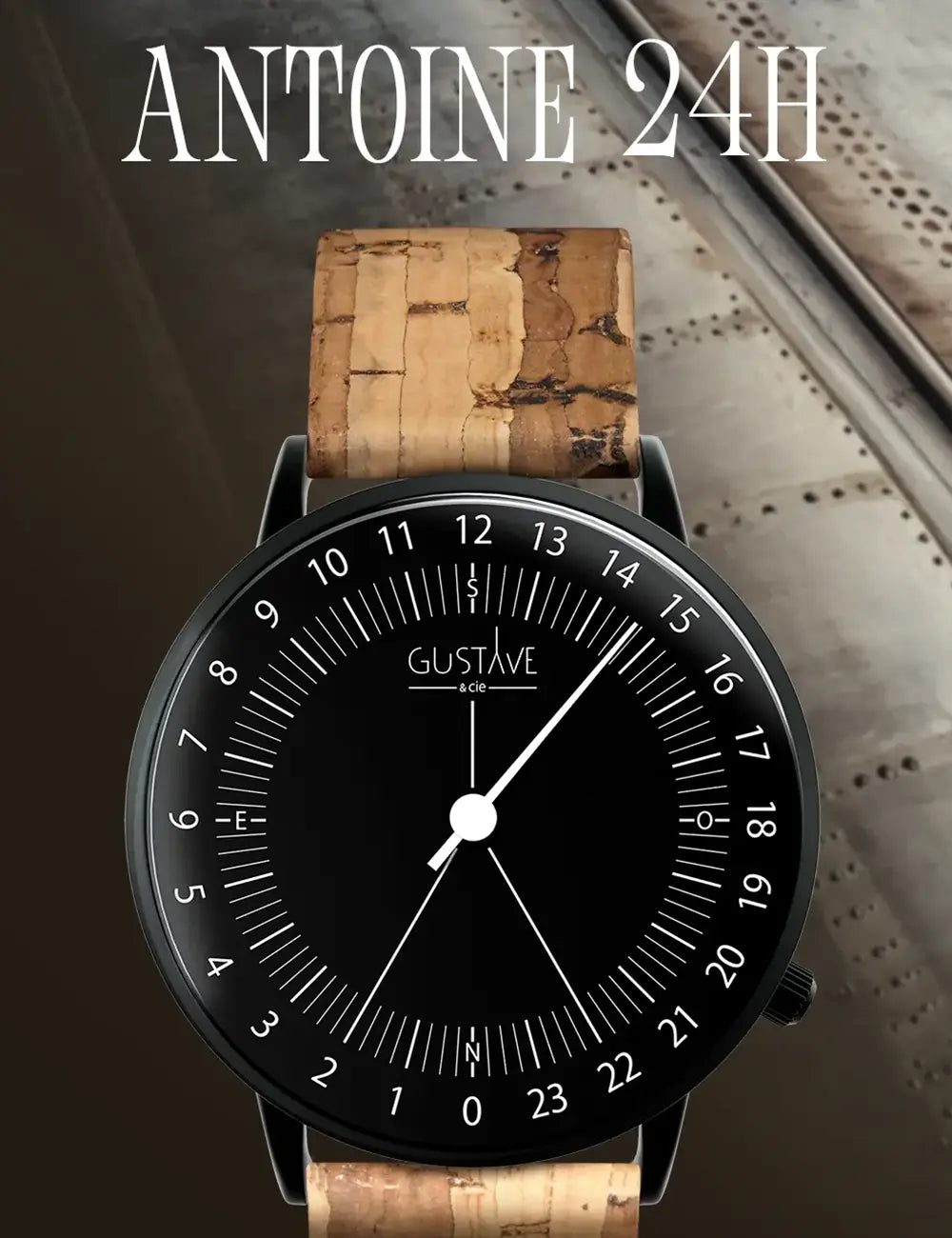
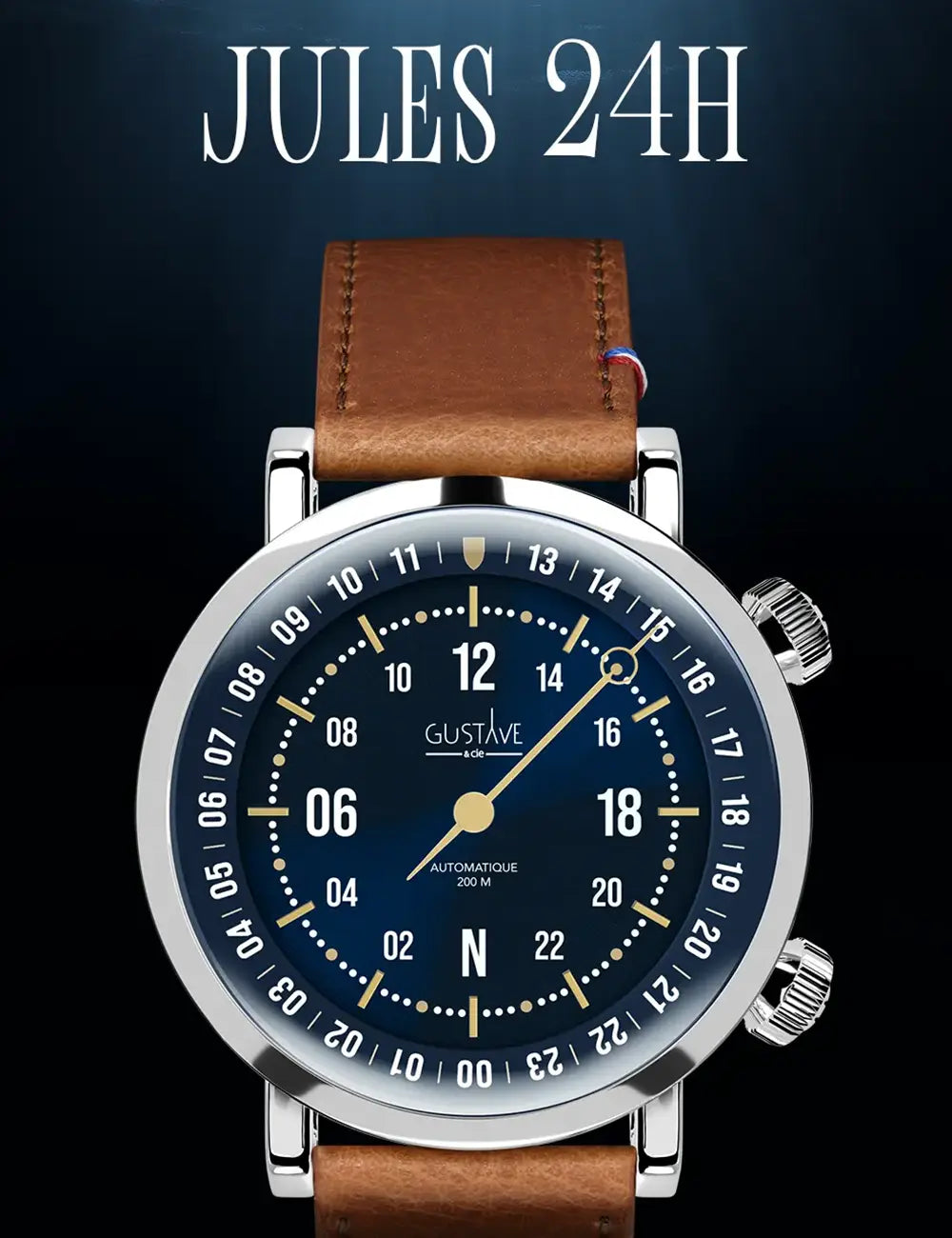
To accompany today's great travellers, horological design has evolved by drawing inspiration from this global vision and this circumnavigation. Reading time on a 24-hour dial, for instance, allows one to embrace the entirety of an Earth day at a single glance. This aesthetic and mechanical innovation recalls the complete rotation of our beautiful planet that Jules Verne so brilliantly dramatised in his timeless writings.
Conclusion
Ultimately, Jules Verne was not merely a visionary writer capable of imagining submarines or space travel. Above all, he reflected deeply on our relationship with time. Through his novels, he demonstrates that time is not solely a constraint, but also a beacon that allows us to explore, understand the world, and push the boundaries of the possible. His tales remind us that every great adventure begins with a decision, a first step... and a mastered sense of time. For behind every exploration, there is always the same underlying idea: knowing where we are, where we are going, and fully enjoying the journey.
Discover our Jules 24h collection, inspired by Jules Verne


Leave a comment
This site is protected by hCaptcha and the hCaptcha Privacy Policy and Terms of Service apply.