







How does a mechanical watch work?
Watching the seconds hand of a timepiece glide smoothly across a dial inevitably raises a question: how does a mechanical watch work? Far from the simple utility of telling time, the heart of a mechanical watch is a true feat of micro-engineering. Devoid of the slightest trace of electronics, this system relies entirely on the fundamental laws of physics.
Understanding the inner workings of a mechanical watch means entering a universe where kinetic energy is captured, mastered, and then released with mathematical precision. Whether you are a curious novice or an enlightened enthusiast seeking a clear explanation of the mechanical movement, this guide reveals the intimate architecture of these miniature engines beating to the rhythm of your wrist.
The mechanical watch: an autonomous system
The primary and most fascinating characteristic of a mechanical watch is its complete autonomy. Unlike modern devices dependent on an external power source or chemical batteries, the mechanical movement is a closed, independent ecosystem. Its basic principle is one of elegant conceptual simplicity: it involves storing an initial motive force, then distributing it in a highly regulated manner over a long period.
There are no printed circuits, quartz, or electricity here. Each component, machined to tolerances in the micron range, physically interacts with its neighbour. It is this purely mechanical constraint that dictates the architecture of the movement. The system must perform three vital, successive functions: the accumulation of power, its smooth transmission, and finally, its precise fractioning. It is the harmony between these three stages that transforms a simple metallic tension into a highly reliable time display.
Energy at the heart of the movement
Any explanation of a mechanical movement begins at its energy source: the barrel. Visually, the barrel resembles a small cylindrical box with toothed edges. Hidden inside this drum is the true "fuel" of your watch: the mainspring. This is a long ribbon of metal alloy, coiled upon itself in a spiral around a central axis called the barrel arbor.
When you wind your watch, you force this spring to coil tightly around its axis, creating a strong tension. The spring then has only one physical "desire": to uncoil and return to its original shape. It is this unwinding force that constitutes the energy of the watch. However, if the spring were free to uncoil instantly, it would release all its energy in a matter of seconds, causing the hands to spin at a frantic speed. The entire challenge of the mechanical movement is therefore to hold back this immense energy and allow it to escape only drop by drop.

Diagram illustrating how a mechanical watch barrel works, with a fully wound mainspring on the left and an empty barrel on the right. This type of mechanism, particularly in manual winding, can be sensitive to excessive tension, potentially leading to a risk of breakage if overwound.
The transmission of energy
To route the energy contained in the barrel to the regulating organ, the watch uses a complex set of gears called the gear train, or wheel train. As soon as the mainspring begins to slowly uncoil, it turns the cylinder of the barrel. The teeth located on the periphery of the latter engage with a first pinion, thus initiating the flow of energy.
The gear train is generally composed of several overlapping wheels (the centre wheel, the third wheel, the fourth wheel). Each wheel is coupled with a much smaller pinion. This gear ratio plays a fundamental role: it transforms the very slow, powerful rotation of the barrel into much faster, lighter rotations at the extremities of the movement. It is thanks to this transmission engineering that the raw energy is refined and the mechanical flow remains continuous, fluid, and ready to be divided into units of time.
The regulator: the rhythm of time
The energy, now delivered with the correct force, reaches the beating heart of the watch: the escapement and the regulating organ. This is where the explanation of how a mechanical watch works truly makes sense. The regulating system consists primarily of the escape wheel, the pallet fork, and the balance wheel and hairspring assembly.
The balance wheel, coupled with its ultra-fine spring (the hairspring), acts like the pendulum of a grandfather clock, but in a miniaturised and rotary fashion. It oscillates back and forth at an extremely precise frequency. The pallet fork, a small T-shaped component equipped with ruby pallets, forms the link between this oscillating balance wheel and the gear train. With each oscillation of the balance wheel, the pallet fork releases one, and only one, tooth of the escape wheel. It is this constant stopping and starting that produces the famous characteristic "tick-tock". The escapement thus acts as an intelligent brake: it prevents the barrel from emptying all at once, while giving the balance wheel the micro-impulse it needs to continue oscillating without stopping. The energy is now divided into equal fractions of a second.

Explanatory diagram of how the balance wheel, hairspring, and ruby-equipped pallet fork work in a mechanical movement, illustrating the key role of these components in the regulation and precision of the watch.
From energy to readable time
Once the energy has been tamed and divided into a perfect rhythm, this frequency must be translated into information that the human eye can understand: the time. This is the role of the motion work, a distinct network of gears located directly beneath the dial of the watch.
The motion work connects to the main gear train (often at the centre wheel or the fourth wheel) and divides these rotations to correspond to our reading of time. Through a precise set of gear ratios, it ensures that the minute hand turns sixty times slower than the seconds hand, and that the hour hand advances twelve (or twenty-four) times slower than the minute hand. The display of time that you read on the dial is therefore merely the visual culmination of a long ballet of energy, transmission, and mechanical regulation.
A universal mechanical architecture
What makes the functioning of a mechanical watch so remarkable is the overall balance of its architecture. It is a micro-machine where every component is indispensable. If the barrel spring is too powerful, it risks accelerating the escapement. If the balance wheel is too heavy, it will consume too much energy.
The precision of such a watch depends on the perfection of its adjustment. Watchmakers meticulously adjust the tension of the hairspring and the inertia of the balance wheel to ensure that the oscillations remain regular, regardless of the position of the wrist or the remaining tension in the mainspring. Observing this mechanism is akin to contemplating a miniature city where energy circulates harmoniously from one district to another, forming a universal system shared by the greatest manufactures.
To go further, mechanics come in several variants
Although the autonomous mechanical system detailed above represents the universal foundation of traditional horology, it is important to note that this vast family comes in several variants. The main difference lies in the method used to wind the barrel spring on a daily basis.
On the one hand, there are manual winding models, which require a regular physical action from the user on the crown. On the other, we find the ingenious mechanism of the automatic watch. Although it shares exactly the same basic architecture (barrel, gear train, escapement), the automatic movement incorporates an additional component called a rotor. This oscillating weight rotates with the natural movements of the wrist, allowing the watch's energy to be continuously recharged without manual intervention. These architectural subtleties, fascinating in themselves, open the door to highly distinct lifestyle choices.

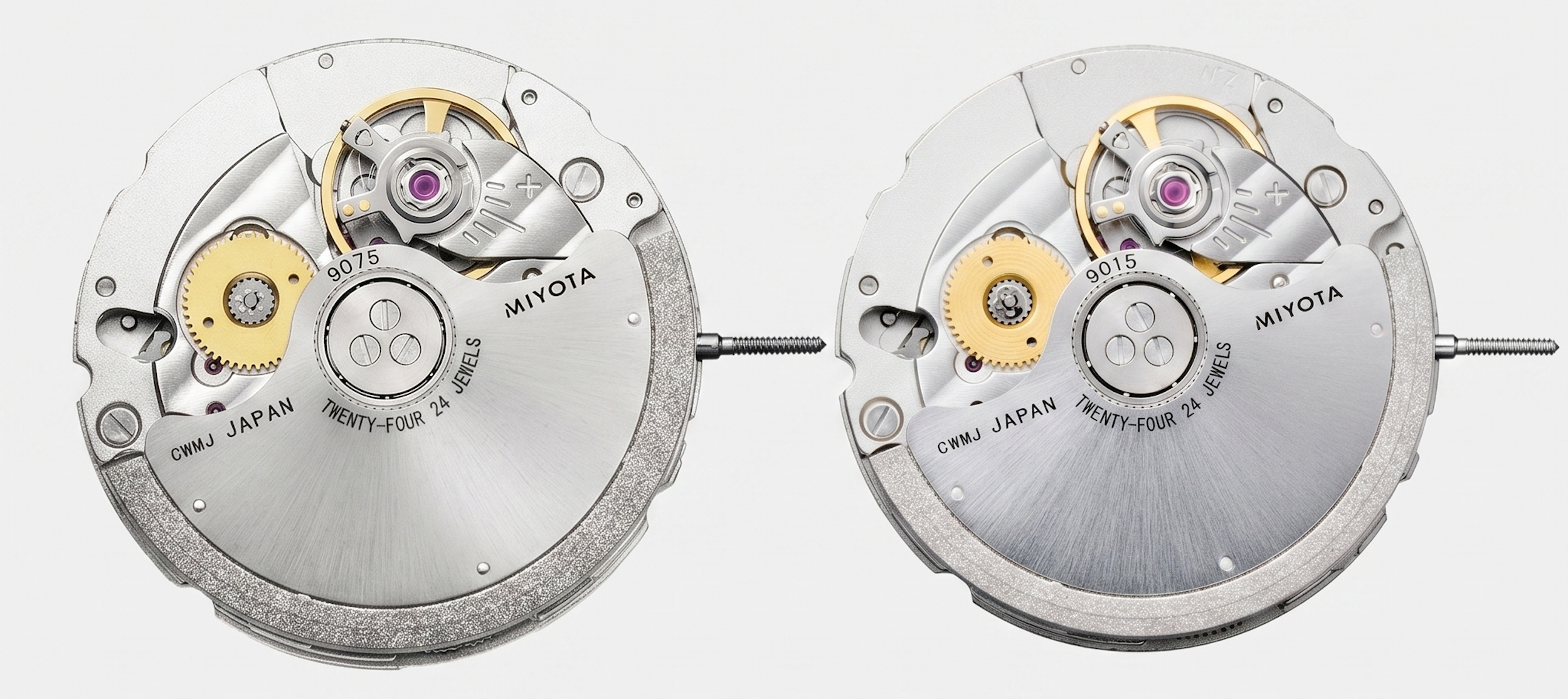
Comparison between a manual mechanical movement and an automatic mechanical movement equipped with an oscillating weight, illustrating two different winding systems in horology.
Conclusion
Ultimately, understanding how a mechanical watch works is about much more than analysing simple gears. It is about grasping a living system, a perfect energetic loop capable of measuring the immaterial. From the raw power stored in the barrel to the poetic precision of the balance wheel, each part contributes to an engineering of time that has been continuously refined over the centuries. The architecture of a mechanical movement, a true explanation of human mastery over matter, reminds us that on the wrist, fine horology offers a physical spectacle whose magic remains intact.
DISCOVER OUR AUTOMATIC MECHANICAL WATCHES

Leave a comment
This site is protected by hCaptcha and the hCaptcha Privacy Policy and Terms of Service apply.